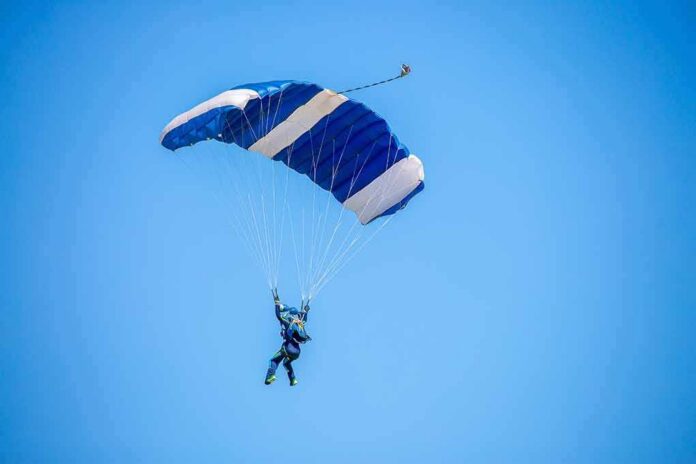
A British skydiver got kicked in the head by a fellow jumper, blacked out in midair, and plunged 10,000 feet with no parachute open — and lived to tell about it.
Story Snapshot
- Skydiver Holly Wiffen was knocked unconscious after being accidentally kicked in the head by another jumper right after leaving the plane.
- She fell roughly 10,000 feet without deploying her parachute before crashing into a conifer tree.
- The tree slowed her fall enough to save her life, though she suffered serious injuries.
- Her story joins a small list of skydivers who survived near-identical freefall disasters over the years.
- Skydiving remains statistically safe, with fatality rates under one per 100,000 jumps in recent years.
A Mid-Air Collision Turns Deadly Fast
Holly Wiffen jumped out of a plane expecting a normal skydive. Instead, another jumper accidentally kicked her in the head seconds after exit, knocking her out cold. With no control over her body, she tumbled through the sky unable to pull her main or reserve parachute. For thousands of feet, she was simply falling, unconscious, with nothing between her and the ground.
Rescuers later said Wiffen was fortunate the collision happened the way it did, because a harder hit or a different angle could have ended far worse. She has said publicly that she knows how close she came to dying, and she credits pure chance for what happened next during her fall.
A Tree Breaks Her Fall When Nothing Else Could
Wiffen’s uncontrolled plunge ended when she slammed into a conifer tree. The branches absorbed enough of the impact to slow her descent just before she hit the ground, and doctors believe that tree is the reason she survived at all. She walked away with serious injuries but was expected to recover, and she has said she plans to jump again.
This is not the first time a tree or heavy brush has been credited with saving a skydiver’s life in Britain. In a separate 2009 case, a man survived a 10,000-foot fall after his primary parachute failed to open correctly during freefall. Colin Fitzmaurice, who ran the parachute center involved, confirmed the man dealt with both a main parachute malfunction and a problem with his reserve chute.
Not the First Miracle in Freefall History
Survival stories like these are rare, but they are not unheard of. A Wikipedia-documented list of falls survived without a working parachute includes multiple cases stretching back decades, including the famous story of Juliane Koepcke, who survived a 10,000-foot fall in a plane seat after a 1971 crash and then hiked eleven days through the jungle to safety. Each case shares a common thread: something, whether trees, brush, or sheer luck, broke the fall just enough.
More recently, a British man named Mitchell Deakin survived an 11,000-foot fall in Nevada in 2025 after both his main and emergency parachutes failed to open during a jump with an instructor. He suffered serious injuries but lived, joining a short but growing list of jumpers whose survival defies the odds most people assume apply to a parachute failure.
Skydiving Remains Rare But Real Risk
Despite these dramatic headlines, skydiving is far safer than most people think. Studies tracking millions of jumps put the fatality rate between roughly 0.23 and 1.24 deaths per 100,000 jumps, with injuries far more common than deaths. The United States Parachute Association reported just nine fatalities out of 3.88 million jumps in 2024, the lowest rate on record for the sport.
WATCH: Skydiver survives terrifying 10,000ft PLUNGE UNCONSCIOUS — The Sun
Holly Wiffen was struck in the head by another jumper, sending her into an uncontrolled fall
She eventually deployed her chute & escaped with a shattered leg & spinal fractures after crashing into a tree pic.twitter.com/eO0jRcR6qQ
— RTVisual (@RT_Visual_on_X) September 7, 2026
Medical researchers note that most serious skydiving injuries happen during the canopy phase, hard landings, or from equipment failure rather than freefall itself. Wiffen’s ordeal fits that pattern exactly. Her injuries came from a violent, uncontrolled landing, not from the fall through open air, a reminder that the margin between tragedy and a miracle survival story often comes down to seconds and inches.
Sources:
mirror.co.uk, bbc.com, sportschosun.com, telegraph.co.uk, timesofindia.indiatimes.com, nypost.com