When a school bus carrying visually impaired students crashes into a neighborhood pharmacy, the real story is not only the frightening impact but how a layered safety system—involving drivers, contractors, police, and emergency responders—either works as intended or reveals its weak points.
Key Points
- A Baltimore County Public School bus transporting Maryland School for the Blind students left the roadway and crashed into a Parkville pharmacy building on the afternoon of July 21.
- Three people – the bus driver, one student, and another adult at the scene – were hospitalized with minor injuries; additional children and adults were evaluated on site and declined transport.
- Police investigators say a southbound Ford Focus crossed into the northbound lane and into the bus’s path, triggering a multi-vehicle collision that ended with the bus embedded in the building.
- Emergency services and school administrators responded quickly, containing injuries and stabilizing the scene, while the building’s structural safety was assessed before the bus was removed.
- The crash sits within a broader pattern in bus safety: rare but high-profile incidents involving school buses demand careful scrutiny of driver oversight, vehicle technology, and roadway risk without overstating systemic failure.
What Happened in Parkville: A Clear Picture of a Frightening Afternoon
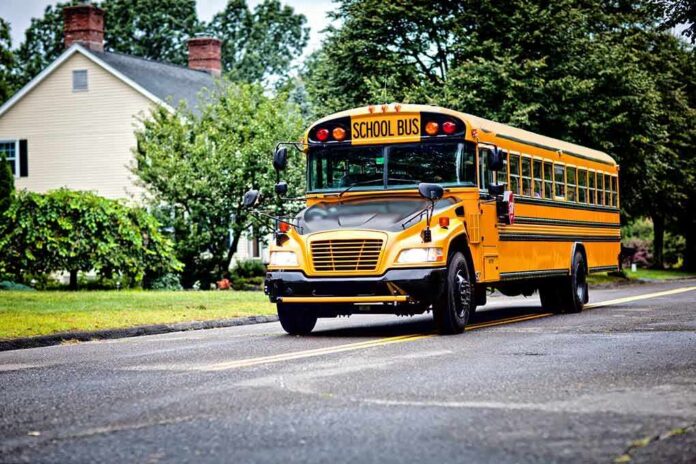
Shortly after 2 p.m. on a July weekday, a Baltimore County Public School bus contracted to transport students from the Maryland School for the Blind was traveling along Harford Road in Parkville when an ordinary route turned extraordinary. Investigators later described a chain of events that began not with the bus, but with a passenger car: a 2017 Ford Focus traveling southbound crossed the center line into the northbound lane, directly into the bus’s path. In the seconds that followed, the Focus struck a 2014 Nissan Altima and forced the bus off its course. Unable to stop in time, the bus continued forward and slammed into the side of a commercial building housing a pharmacy.
Witnesses described the impact as explosive—two loud booms, the ground shaking, merchandise knocked off walls, and an employee pinned between the bus’s front bumper and interior structures. Photos released by the Baltimore County Fire Department show the bus partially inside the building, illustrating just how much kinetic energy a large vehicle carries when it leaves the roadway at speed. For those living and working along Harford Road, the crash was “a very scary moment,” made more unsettling by claims that accidents at that intersection are common.
Who Was Hurt and How Emergency Response Worked
Despite the dramatic visuals, the human toll was limited. The bus was carrying three students and two adults. Baltimore County officials and subsequent police summaries agree that three people were ultimately transported to local hospitals: the bus driver, one student, and another adult who was not on the bus but was injured at the scene. All were reported to have minor injuries. Additional children who had been on the bus, as well as several other people present in and around the building, were medically evaluated where they stood—two more bus passengers and eight other individuals—but they declined transport after assessment.
Those numbers mattered, and they did not settle immediately. Early breaking-news segments variously reported two adults and two children hospitalized, three hospitalized, or one child plus two adults, reflecting the inevitable uncertainty while first responders triage multiple patients in a confined, chaotic environment. By the following day, the Baltimore County police and fire narrative had converged on three minor hospitalizations and multiple refusals, providing the most stable account. In practical terms, that evolution is typical rather than exceptional: media counts reflect a moving snapshot, whereas police crash teams are tasked with assembling an accurate record after the fact.
Cause and Mechanics: From “Out of Control” to Documented Chain of Events
Initial national coverage described an “out-of-control” bus that had “careened off the road” into a pharmacy, language tailored to the shock value of a school bus embedded in a building. That framing is emotionally understandable but technically incomplete. By the time Baltimore County’s Crash Team issued an update, the narrative had shifted from speculation about driver behavior or weather to a more precise sequence involving another vehicle: a Ford Focus that crossed into the bus’s lane, initiating the crash.
In that account, the bus is not the first failure but the last link in a chain. A single lane deviation by a smaller passenger car forced evasive action and created a multi-point collision—Focus into bus, Focus into Altima, bus into building. It is a familiar pattern in roadway safety work: when one vehicle violates the geometry of the road, especially on busy urban corridors, heavy vehicles like buses have limited options and limited stopping distance.
Weather did complicate the investigation. Reporters on scene noted heavy rain, thunder, and lightning in the area during and after the crash, conditions that made both driving and evidence collection more difficult. Yet, unlike some prior high-profile bus crashes, there has been no official suggestion that the bus driver was medically impaired, speeding, or otherwise at fault; the preliminary causation centers squarely on the Focus crossing lanes. That distinction matters, especially in a region with vivid memory of a previous Baltimore school bus crash where federal investigators later found that driver medical disqualification and oversight failures were central.
The Maryland School for the Blind, Bus Contracting, and Vulnerable Students
The presence of students from the Maryland School for the Blind adds gravity to what might otherwise be treated as one more urban traffic incident. The school serves visually impaired and blind children from across the state, relying on contracted school buses to move students safely through environments inherently designed for sighted people. In this case, the bus was a Baltimore County Public School vehicle used under contract to transport MSB students, a common arrangement in special-education transportation.
Following the crash, the Maryland School for the Blind issued a statement confirming that its administrators responded immediately to the scene or to students at the receiving hospital and emphasizing gratitude toward Baltimore County fire, EMS, police, and hospital personnel. That kind of communication serves several functions: reassuring families that the school is actively engaged, signaling cooperation with investigators, and underscoring that, despite frightening imagery, no student suffered serious injury. For parents of children with disabilities, trust in the transportation system is always precarious; incidents like this either erode or reinforce that trust depending on how transparently institutions respond.
Harford Road, Local Risk Perception, and the Gap Between Fear and Data
Intersections like Harford Road and Lavender Avenue in Parkville are not unusual: multi-lane corridors carrying commuter traffic past small businesses, medical offices, and pharmacies, with frequent turns and mixed driving behavior. Residents interviewed after the crash spoke of speeding traffic, dangerous U-turns, and a history of numerous accidents “in front of the store.” Whether that reflects statistically elevated crash risk or the natural accumulation of vivid memories at a familiar corner is an open question, but the perception itself is important.
From a roadway-safety perspective, local anecdotes often prompt authorities to review signal timing, signage, lane markings, sight lines, and enforcement patterns. Yet the investigation into this crash, as described by Baltimore County police, identifies a specific, individual lane incursion by the Focus as the precipitating event. That does not rule out road design as a contributing factor—some layouts make such errors more likely—but it does anchor responsibility in driver behavior rather than in structural failure. For concerned neighbors, the takeaway is nuanced: their road may, indeed, warrant a design review, but the Parkville bus crash is best understood as a discrete incident in which one car’s path deviation put dozens of others at risk.
School Bus Safety in Context: Rare Catastrophes, Visible Near-Misses
Whenever a school bus crashes into a building, it inevitably calls to mind prior major incidents and broader questions about bus safety. Nationally, school buses remain one of the safest ways for children to travel, with severe injury and fatality rates significantly lower than for private vehicles on a per-passenger-mile basis. Yet the rare catastrophic cases loom large: for example, a 2016 Baltimore school bus crash in which the National Transportation Safety Board later found that a medically unfit driver, poor contractor oversight, and the absence of collision-avoidance technology contributed decisively to a fatal multi-vehicle collision.
Against that backdrop, the Parkville crash stands out precisely because it did not escalate to catastrophe. Here, the bus was reportedly operated by a county school system under standard contract, and current evidence does not suggest driver incapacitation or gross negligence. There is no allegation that the bus was mechanically defective or that its operator was medically disqualified, the kinds of systemic issues that marked the earlier NTSB case. Instead, the bus behaved as any large vehicle might when confronted with an unexpected car crossing its lane: its momentum carried it forward into the most proximate obstacle, in this case a building wall.
Still, even a non-fatal event exposes limitations. Traditional school buses often lack modern collision-avoidance systems and automatic emergency braking, technologies the NTSB has already flagged as absent contributors to crash severity in past cases. In Parkville, such a system might not have prevented the Focus from entering the bus’s path, but it could conceivably have reduced impact speed or altered the bus’s trajectory. For risk managers and policymakers, the lesson is that “minor injuries” today should not be cause for complacency; they are an opportunity to harden a system before luck runs out.
Several people were taken to area hospitals after a school bus carrying students from the Maryland School for the Blind crashed into a building in Parkville on Tuesday afternoon, prompting emergency crews to declare a mass casualty incident.
The crash happened shortly after 2:40… pic.twitter.com/aXVYk4gTXI
— The Baltimore Sun (@baltimoresun) July 21, 2026
What Remains Unresolved and Why It Matters Going Forward
As with most serious traffic incidents, the public record on the Parkville bus crash is still incomplete. The police Crash Team’s preliminary account identifies the key initiating maneuver but not yet the underlying reasons—whether distraction, impairment, mechanical failure, or a momentary lapse contributed to the Ford Focus crossing lanes. Formal crash reports, including diagrams, measurements, and any reconstruction work, will fill in those gaps, and may influence whether charges are filed or civil liability is established.
Medical details, too, remain properly private. “Minor injuries” is a broad, non-clinical term; bruises and soft-tissue strains sit alongside fractures and concussions in that category, and downstream effects for a visually impaired child or an adult pinned against a wall can be significant even if they do not meet trauma thresholds. What is public, and sufficient for understanding the event, is that there were no fatalities, no life-threatening injuries reported by officials, and that all transported patients were stable.
For Baltimore County and the Maryland School for the Blind, the stakes going forward are clear. The crash is a reminder of how dependent vulnerable students are on a network of safety that spans bus design, driver vetting, route planning, and roadway engineering. This incident, unlike some past ones, appears to showcase a system that largely worked under stress: an initiating error by one car produced a dramatic collision, but seatbelts, bus structure, driver response, and rapid emergency care combined to prevent serious harm. The challenge now is to treat it not as a one-off scare but as a case study for reinforcing that network before the next test arrives.
Sources:
nypost.com, youtube.com, wbaltv.com, foxbaltimore.com, facebook.com, patch.com, baltimoresun.com