
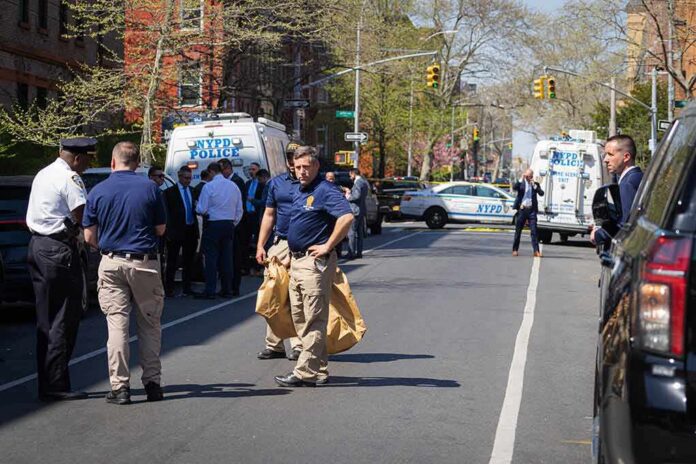
When an off-duty detective is stabbed seven times on a Bronx sidewalk in broad daylight and leaves the hospital days later to applause from colleagues, you’re looking at more than a headline; you’re seeing how a single violent incident concentrates the realities of street crime, officer victimization, and the speed at which law-enforcement-driven narratives take hold — all at once.
The Short Version
- Detective Jose Mercedes, 33, was stabbed multiple times during an attempted robbery near East 208th Street and Rochambeau Avenue in the Bronx.
- Two suspects approached on a motorized bike, tried to steal his chain, and fled after the attack; a multi-agency hunt followed.
- Mercedes was taken to Jacobi Medical Center, stabilized, and released a few days later to a “clap out” by peers.
- Police later identified two men wanted on attempted murder and robbery charges; Homeland Security said both were in the U.S. unlawfully.
What Happened: The Attack, The Chase, The Release
Shortly before 2 p.m. in the Norwood section of the Bronx, two men on a motorized bike approached off-duty Detective Jose Mercedes near his vehicle; in the ensuing struggle to rip a chain from his neck, the assailants stabbed and slashed him repeatedly, then fled on the bike. The working picture from police and multiple newsrooms is consistent on the essentials — time window, location, modus operandi, and victim status. Witnesses described Mercedes pursuing the attackers on foot for a stretch before collapsing; officers and EMS responded within minutes. He was transported to NYC Health + Hospitals/Jacobi, stabilized, and days later left the hospital to cheers from fellow officers and city leadership who had visited him at the bedside.
Accounts across outlets vary at the margins — exact intersection naming, the count of wounds (often reported as seven), and whether the chain was fully taken during the attack — but not on the core: an off-duty detective, a daytime robbery attempt, multiple stab wounds, a flight on an e-bike, and a rapid medical response followed by recovery and public “clap out.” Taken together, these are the uncontested facts the investigation and subsequent briefings have anchored to.
The Investigation: How Identifications Happen Fast
In New York City, serious street felonies against an identifiable victim — especially a police officer — trigger a well-worn investigative playbook. Detectives map the crime scene perimeter to the likely ingress/egress routes of the suspects; they canvass for cameras along flight paths, pull footage, and extract stills to circulate internally and, when strategic, publicly. Within days of the attack on Mercedes, the NYPD released images and surveillance video of the two suspects, including clear frames of one man who lost his shirt in the struggle, and asked the public for help. That request was not performative; tips and camera corroboration routinely close the gap between a grainy first frame and a nameable subject.
By October 6, police named two suspects and indicated that both faced attempted murder, robbery, and weapons charges — a triad that matches the conduct described (a violent taking, use of a blade, and life-threatening injuries). According to follow-on reporting that drew on Homeland Security information, both men were in the country unlawfully; one reportedly had prior arrests in New York City. These details matter because they shape the extradition, custody, and detainer posture once suspects are located across state lines and returned to face New York charges.
The Crime Pattern It Reflects: E-Bikes, Quick Jackings, Bladed Violence
What makes this incident legible to veteran investigators is how it overlaps with known robbery patterns. The use of an e-bike or scooter to approach and flee compresses the window for a victim to react and expands the suspects’ operational radius beyond the immediate neighborhood. A gold chain grab is a classic “snatch” predicate that can escalate when the victim resists — and off-duty officers often do, instinctively, even without backup. A knife or slashing instrument is common in such robberies because it is concealable, requires no procurement of ammunition, and can be used to create separation quickly. Several of these elements, visible here, have been observed repeatedly in Bronx and northern Manhattan robbery sprees over the past few years, with video releases frequently aiding identification and arrest.
The aftermath — a sustained foot chase by a bleeding victim, followed by a collapse within a few blocks — also tracks with physiology: adrenaline can carry a stabbed person farther than common sense suggests, only to yield sharply as blood loss and pain assert themselves. That pattern is echoed in witness accounts and the geographic breadth of the secured scene after the attack.
Why Officer Attacks Resonate: Institutional Visibility and Public Messaging
Crimes against police officers receive disproportionate attention for structural reasons, not just sentiment. The department controls early information flow; a large press contingent is already wired into NYPD communications; and the event provides a narrative frame that is easy to understand: a sworn officer harmed, a city responding. This concentration effect can harden the public storyline ahead of case filings, a phenomenon repeatedly visible in New York crime coverage. The Mercedes case followed that arc: rapid alerts, surveillance imagery within about a day, hospital updates, and leadership bedside visits — all of it designed to focus the public on the conduct at issue and to help generate leads.
That does not diminish the underlying reality. An off-duty detective was stabbed multiple times while fending off a robbery; he survived, cooperated with investigators, and left the hospital to the applause of peers. The subsequent identification of suspects, with charges that match the described conduct, is the proper next step. What the amplification does is ensure the public sees the case as emblematic of a broader fight over street safety and accountability — which is precisely how police and political institutions want it seen.
The Legal Path Ahead: Charges, Extradition, and Custody
When suspects are identified in another jurisdiction, the process is mechanical: locate, arrest on the New York warrant or a fugitive-from-justice equivalent, present in local court, and arrange extradition. In cases with federal immigration interest, ICE may file detainers; those do not displace state criminal custody but shape post-arraignment detention and potential removal after disposition. Attempted murder and first-degree robbery are violent felonies in New York; courts weigh injury severity, flight risk, and criminal history in remand decisions. Given the violent facts as described, prosecutors typically seek high bail or remand. Once back in New York, expect a grand jury presentation on top counts and a motion practice calendar focusing on identification evidence — surveillance, witness statements, and any forensic recoveries.
What This Means for New Yorkers
Three takeaways endure beyond the news cycle. First, the operational tempo of modern street robberies — leveraging mobility devices and quick grabs that can turn lethal — is not speculative; it’s visible on film and borne by victims’ injuries. Second, when a police officer is the victim, the investigative machinery can move with unusual speed and public coordination; the same playbook, scaled and resourced, solves a great many civilian cases too. Third, the case will now turn on standard evidentiary work: camera-to-suspect attribution, chain-of-custody integrity for any recovered items, and the coherence of witness accounts across time. Those are the tests that convert a vivid incident into a sustainable prosecution.
The detective’s recovery does not erase the violence; it affirms what trauma care and fast police response can accomplish. If the identified men are returned to face charges, the courtroom will do the next part of the city’s work: translating a frightening few minutes on a Bronx corner into a record, a verdict, and — for those who live and work along those blocks — a measure of accountability that outlasts the sirens.
Police say two men accused of stabbing and robbing an off-duty NYPD detective in the Bronx were arrested overnight in Massachusetts after authorities found them hiding in the basement of a home. https://t.co/sRzXf8YZGO pic.twitter.com/CVYSpwdDlx
— Eyewitness News (@ABC7NY) October 7, 2026
Sources:
nypost.com, bronx.news12.com, nydailynews.com, wfmd.com, officer.com, cbsnews.com, nbcnewyork.com