
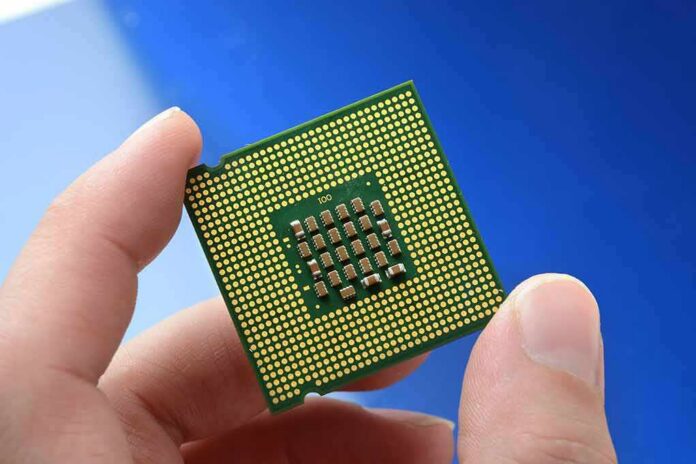
China’s tightening grip on indium phosphide is not a single dramatic cutoff, but a deliberate use of export licensing and customs scrutiny to inject uncertainty, cost, and leverage into the supply chain that underpins the physical build‑out of AI data centers.
Key Points
- Beijing formally placed indium phosphide and related indium items under dual‑use export controls in February 2025, creating a licensing chokepoint rather than a blanket embargo.
- The regime has driven a roughly 250% price surge in 6‑inch InP wafers and contributed to substrate shortages and revenue hits for key suppliers like AXT, constraining photonics components for high‑speed AI interconnects.
- Controls operate through discretionary license approvals, end‑user scrutiny, and delayed permits across multiple destinations, affecting U.S., European, and Asian buyers rather than targeting the United States alone.
- Because InP sits at the heart of optical links inside AI data centers, China’s policy joins a broader pattern of two‑front pressure: leveraging materials chokepoints while simultaneously pushing indigenous alternatives to Western, GPU‑centric AI architectures.
China’s Indium Phosphide Controls: What Beijing Actually Did
The starting point is clear and documented: on 4 February 2025, China’s Ministry of Commerce and the General Administration of Customs issued Announcement No. 10, adding specific indium‑related items to the country’s dual‑use export control list. The controlled items include indium phosphide substrates (classified as 3C004.a), the key precursor chemicals trimethylindium and triethylindium (3C004.b and 3C004.c), and associated production technology and process data (3E004). Exporters must obtain a license from the competent commercial authority under the State Council before any of these items leave the country, and the announcement took effect immediately.
Crucially, refined indium metal was not included in the February 2025 list; the focus is on InP substrates and the upstream chemistry and know‑how required to fabricate them. Subsequent reporting underscores that distinction: while indium metal itself remained formally outside the control list, customs officers began stepping up scrutiny of indium exports more broadly, demanding detailed end‑user information and slowing approvals for buyers in Europe and North America. The legal regime, in other words, carves out a narrow but strategically chosen slice of the indium value chain, then reinforces it with discretionary administrative practices that can be tightened or relaxed as circumstances dictate.
Licensing Friction, Not a Formal Embargo
Despite alarmist rhetoric in some commentary, the public record does not support the claim that Beijing has imposed an outright embargo on InP. Reuters’ June 2026 coverage, drawing on buyer interviews and customs checks, explicitly notes that it has not identified any shipments that were permanently halted under the regime. Instead, buyers report longer approval times, additional documentation requests, and a general sense of uncertainty around license processing—classic signatures of a discretionary export‑licensing system rather than a categorical ban.
Supplier experience tracks that picture. AXT, one of the two dominant global producers of InP substrates alongside Sumitomo, disclosed that its Q4 2025 revenue came in below guidance largely because fewer export control permits were issued by China’s Ministry of Commerce than expected. AXT received its first permit to resume InP exports only in late June 2025, months after the controls took effect, confirming that the bottleneck sits in license issuance rather than physical output capacity. That pattern—materials available, but permission to ship lagging—is consistent everywhere the regime shows up in the record.
Why Indium Phosphide Matters for AI Infrastructure
Indium phosphide is not just another specialty compound; it occupies a bottleneck position in the optics stack that keeps modern AI data centers from choking on their own data. InP substrates serve as the foundation for lasers and high‑speed optical chips that move information between GPUs and servers inside hyperscale facilities. Unlike silicon, which struggles at the highest frequencies and distances required for dense AI clusters, InP supports the modulation speeds and low noise characteristics needed for multi‑terabit optical interconnects.
The value chain is layered. Companies like AXT fabricate the bare InP wafers. Epitaxy houses then deposit ultra‑precise compound semiconductor layers on those wafers. Only after that do firms such as Broadcom, Intel, or Marvell build finished optical transceivers and integrated photonic chips. Interruptions at the wafer stage have a magnified downstream effect: fewer substrates mean fewer epitaxial starts, fewer lasers, and ultimately fewer optical modules available to slot into AI racks. As AI data center designs push toward ever‑tighter GPU clusters with heavier east‑west traffic, optical bandwidth ceases to be a luxury add‑on and becomes the rate‑limiting physical constraint.
The Price Shock and Its Downstream Ripples
By mid‑2026, that upstream chokepoint translated directly into prices. Multiple reports, building on Reuters data, show that the average cost of a 6‑inch InP wafer climbed from roughly $1,400 before the controls to about $5,000 afterward—a roughly 250% increase as buyers competed for constrained supply. This is not a small adjustment; at scale, it revalues entire bills of materials for optical modules and forces designers to revisit cost assumptions for next‑generation AI data centers.
Industry narratives echo the squeeze. Digitimes describes China’s export restrictions as having “triggered a shortage of InP substrates,” creating a bottleneck for high‑speed optical communications in AI applications. Semiconductor‑focused coverage of AXT details order backlogs extending toward 2030, capacity expansion plans, and explicit warnings about export controls as a material risk factor for revenues tied to AI demand. When a single upstream material sees both explosive demand and politically constrained supply, it ceases to be a routine input and becomes a strategic choke point in its own right.
A Global Constraint, Not a U.S.-Only Weapon
The core question driving much commentary is whether China’s InP regime is a tailored attempt to slow U.S. AI deployment or part of a broader resource‑control strategy. On the evidence currently available, it is more accurate to describe the policy as globally constraining rather than uniquely targeted at the United States. European buyers have reported, for the first time, being asked to provide detailed end‑user information and locations for indium purchases. North American buyers have experienced longer approval times, worrying that indium metal itself could be drawn into the formal control framework.
There is, at this stage, no primary‑source documentation showing country‑specific licensing criteria or denial policies that single out U.S. destinations. The underlying legal text for Announcement No. 10, as summarized in trade commentary, lists items and licensing obligations but does not articulate targeted geopolitical motives or differentiated treatment by importing country. That absence of explicit targeting language does not mean the policy is benign—it clearly raises global prices and injects risk—but it does undercut claims that Beijing has, on paper, crafted an InP regime aimed solely at U.S. AI infrastructure.
Strategic Export Management: Optional Friction as a Tool
The InP episode fits neatly into a broader pattern of Chinese strategic export management. Over the past several years, Beijing has steadily expanded its dual‑use and technology export control lists, covering rare earth elements, gallium, germanium, gallium arsenide, and now indium phosphide. The stated rationale in some cases emphasizes military applications and national security; AXT, for example, notes that China’s government imposed restrictions on GaAs and InP aiming to restrain exports of materials used in military systems and requiring a permit for every customer order.
Mechanistically, the power of such regimes lies less in outright denial and more in “optional friction”: the ability to slow approvals, demand extra end‑user documentation, and create enough uncertainty that buyers must either pay up, reconfigure supply chains, or seek policy concessions. Licensing systems can be dialed up or down based on trade tensions, tariff cycles, or diplomatic negotiations, giving Beijing a flexible lever without the reputational or economic cost of a declared embargo. That same ambiguity, however, makes it harder for outside observers to prove intent; effects are measurable—prices, backlogs, delays—while motives remain inferential.
The Two-Front Squeeze: Materials Leverage and Architectural Diversification
For U.S. and allied policymakers, the InP controls matter not only because they constrain today’s AI build‑out, but because they sit alongside a second, quieter front: China’s pursuit of alternative hardware and energy architectures that aim to sidestep Western chokepoints entirely. Recent research out of Nanjing University demonstrated sub‑1 nm transistors built on two‑dimensional molybdenum disulfide, using antimony contacts grown via molecular beam epitaxy to overcome the contact resistance problems that have plagued earlier 2D devices.[Quantum Silk Route video summary] In parallel, Peking University unveiled a domain‑specific AI accelerator optimized for multifield computations rather than general‑purpose GPU workloads, expressly designed to work around dependence on Nvidia’s leading chips.
Taken together, these efforts signal a dual‑track strategy. On one track, China uses export controls over materials like InP to exert leverage over global AI infrastructure, adding friction and cost to rivals’ build‑out. On the other, it invests in non‑silicon logic, photonics, and even fusion energy research that, if successful, would allow domestic AI capacity to grow without relying on the same Western‑dominated inputs and equipment. In a world where U.S. policy has leaned heavily on export controls for advanced lithography and GPUs, shifting the battlefield to compound semiconductors and domain‑specific accelerators is a logical countermove.
In early May, the CEO of American chipmaker Coherent flew to China with President Trump after warning investors his company was running short of indium phosphide, a key material that turns electricity into laser light for high-speed data links in AI data centers.
China produces… pic.twitter.com/pKWhNcvZit
— The Epoch Times (@EpochTimes) July 26, 2026
Can Substitution and Diversification Blunt the Choke Point?
Neither the physics nor the market leaves the United States without options. One response is straightforward diversification: encourage non‑Chinese InP capacity in countries such as the United States, Japan, and within Europe, while stockpiling critical inputs and supporting long‑term purchase agreements that justify new fabs. AXT’s own filings emphasize both the risks of over‑reliance on Chinese export permits and the strength of demand stretching into the next decade, suggesting there is commercial room for alternative capacity if political risk is priced correctly.
Another response is technological substitution. Photonics firms and investors increasingly focus on materials that can deliver comparable or superior performance without exposure to Chinese controls. Organic electro‑optic polymers, such as the perkinamine platform discussed by U.S. company Lightwave Logic, aim to replace brittle, heat‑sensitive InP modulators with silicon‑compatible, highly efficient alternatives produced entirely within Western fabrication ecosystems.[Market Mavericks video summary] Thin‑film lithium niobate represents another candidate, though it currently faces manufacturing scale challenges. The pace and success of these substitution efforts will determine whether InP’s bottleneck status persists or recedes over the second half of the decade.
What This Means for U.S. AI Build-Out
The evidence to date supports a clear, if nuanced, assessment. China’s InP export‑control regime has materially increased costs, created localized shortages, and introduced significant licensing uncertainty for global AI data‑center supply chains. It operates through discretionary approvals and heightened scrutiny rather than categorical bans, affecting multiple destinations rather than targeting U.S. buyers alone. It fits into a broader toolkit of strategic export management designed to give Beijing coercive leverage without the blunt instrument of embargo.
What remains unproven—and may stay opaque absent leaks or detailed official documentation—is the precise degree to which these controls have delayed specific U.S. data‑center deployments or constrained GPU cluster rollouts. No rigorous, destination‑specific study has yet linked license delays to quantifiable lost AI capacity in the United States. Yet for serious planners, that lack of quantified impact does not erase the strategic signal. When a rival controls roughly 70% of global indium output, sets discretionary rules on the most AI‑critical indium compound, and simultaneously explores hardware paths beyond Western export controls, the rational assumption is that materials policy and technology strategy are being used in concert, not in isolation.
Sources:
zerohedge.com, reuters.com, timesoftunis.com, x.com, kucoin.com, thenextweb.com, digitimes.com, linkedin.com, facebook.com, semiconductor-today.com