
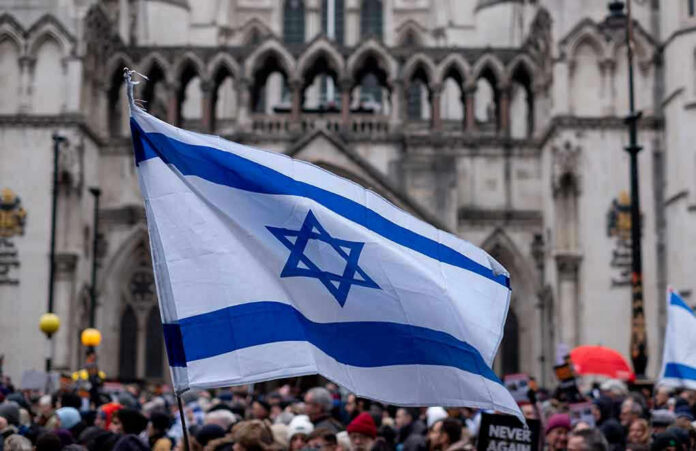
A federal judge ruled that yanking a Star of David Israeli flag from a woman’s neck can be racial discrimination, not “protest.”
Story Highlights
- A federal court let a civil-rights suit proceed and granted preliminary relief in Sumrall v. Ali.
- The judge linked the Star of David on Israel’s flag to Jewish identity when assessing motive.
- A United States Capitol Police officer’s testimony supported a likely battery finding at this stage.
- A stay-away order requires the defendant to keep distance and avoid contact with the plaintiff.
Judge’s Ruling Treats Force Against a Jewish Symbol as Discrimination
Judge Trevor N. McFadden of the United States District Court for the District of Columbia allowed Kimmara Sumrall’s civil-rights case to move forward and granted preliminary relief. The order rests on a finding that the alleged act—yanking an Israeli flag tied around Sumrall’s neck, causing brief choking—can be racially motivated battery, not protected speech. The court tied the Star of David on the flag to Jewish identity when assessing motive. That framing narrows any “it was only protest” defense.
The decision came at the preliminary injunction stage, which asks whether the plaintiff is likely to succeed on the merits. The judge said the evidence supports that standard. Reports say he also issued a stay-away order, requiring the defendant, Janine Ali, to remain at least three yards from Sumrall and have no contact. That practical step signals the court’s view of risk while the case proceeds. It does not decide final guilt or liability yet.
Key Facts the Court Considered at This Stage
Reports say the judge found Ali likely committed battery, pointing to testimony from a United States Capitol Police officer who witnessed the event. The account describes Ali grabbing the flag that Sumrall wore around her neck, which caused choking and pain. That allegation moves the case out of pure speech and into force. Physical contact that harms another person is not protected expression. The court treated that conduct as possible direct evidence of discrimination, given the symbol involved.
The suit includes a claim under the Reconstruction-era Civil Rights Act, 42 United States Code Section 1981, which protects against racial discrimination in making and enforcing contracts, and related activities. The case also advances District of Columbia tort claims, including battery and assault. The judge’s reasoning ties the Star of David to Jewish identity, which supports the view that an attack on that symbol worn by a Jewish woman can show discriminatory intent. That is a narrow but important line the court drew.
Free Speech Has Limits When Force Enters the Picture
Advocacy groups aligned with Ali argue the Israeli flag is a political emblem and that protests are protected speech. They also note a prior criminal acquittal. But the First Amendment does not protect battery. The judge’s order focuses on the alleged choking and the identity-linked symbol. That analysis separates speech from unlawful conduct. The court’s task is not to police views on the Middle East. It is to say you cannot lay hands on someone, choke them, and call it debate.
The ruling is preliminary and not a final judgment. Civil and criminal standards also differ. A criminal acquittal does not bar a civil claim that uses a lower burden of proof. The record in public reports shows why the court issued relief now: the combination of the symbol, the physical act, and a police witness. That mix was enough for likely success at this stage. Further discovery, video, and depositions will test every claim as the case moves ahead.
Why This Matters for Public Safety and Equal Treatment
Americans have the right to speak, pray, and assemble without fear. That includes Jewish Americans who choose to wear a Star of David or Israel’s flag. When a court says that force against a symbol tied to identity can be discrimination, it protects everyone’s freedom to express who they are. That stance also warns agitators that protests cannot cross into hands-on intimidation. It draws a clear line: ideas are legal; choking is not. That is common sense, and it upholds the law.
For readers who value limited government and ordered liberty, this case shows a proper balance. The court did not ban protests or flag criticism. It did not police opinions. It focused on force, motive, and safety. The judge used a narrow tool, a stay-away order, to prevent more harm while facts are tested. That approach guards rights, backs law and order, and rejects excuses for violence wrapped in politics. It is a win for equal protection and for peaceful civic life.
Sources:
reason.com, jpost.com, combatantisemitism.org, codepink.org, adc.org