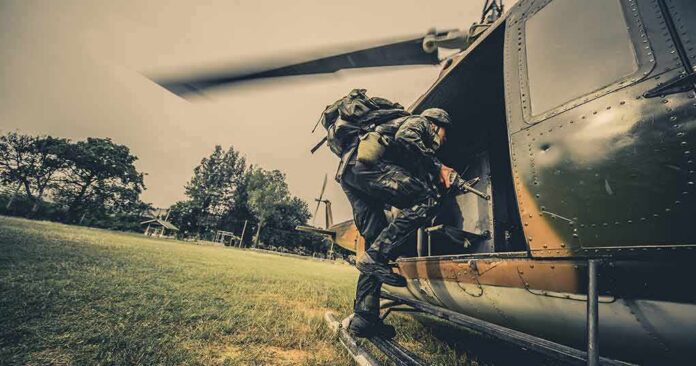
Georgia National Guard helicopters are helping police spot backyard marijuana grows and fast-track search warrants, turning eyes in the sky into courtroom-ready evidence.
Story Snapshot
- Guard aircrews fly with a law enforcement officer to observe suspected grows and support rapid warrants.
- An operation near Dalton used aerial spotting to secure a judge-signed warrant and seize illegal marijuana.
- Summer missions removed 343 illegal plants with state partners, according to official reports.
- Aerial reconnaissance has been part of National Guard counterdrug work for decades.
Guard States Its Role: Aerial Eyes Supporting Probable Cause
Georgia National Guard officials say their counterdrug aviation team provides aerial observation with a local or state officer on board. That officer helps document what is seen to support a rapid search warrant. The Guard describes this as “probable cause generation” that closes resource gaps for police on the ground. The program focuses on illegal marijuana grows and related case support. Officials frame the flights as a routine, long-standing tool that helps law enforcement act quickly and lawfully.
Guard materials explain that the helicopter team can relay details to investigators and prosecutors. That can include location, plant layout, and photos taken by the officer. The goal is to produce clear facts that fit the warrant standard. The Guard’s counterdrug page lists illegal narcotic ground and aerial observation as a core mission. It also highlights air-to-ground coordination that helps officers plan safe approach and seizure operations once a judge approves a warrant.
Dalton Example: Spotting From the Air, Warrant on the Ground
Officials point to a Dalton case from this summer. A Georgia National Guard UH-72 helicopter detected plants behind a private home while a law enforcement officer rode along. That observation, officials say, directly led to a judge-signed search warrant. Police then seized outdoor plants and processed marijuana hidden inside the residence. The Guard published images and captions that match this account during seasonal eradication flights over the area.
The Guard’s public affairs site and Defense Visual Information Distribution Service describe the same Dalton mission profile. They say crews identified illegal cultivated marijuana to assist eradication operations. While the public record does not include the specific warrant number or the officer’s name, the official summary states the aerial sighting supported the warrant process, which ended in seizures at the home.
Scale And History: 343 Plants Removed And A Decades-Old Practice
Georgia officials report that summer operations with state partners removed 343 illegal marijuana plants across communities. The Guard highlights interagency teamwork and aviation support as key parts of those results. The mission fits a wider pattern that dates back many years. Past state reports logged National Guard flight hours tied to eradication. National Guard testimony from the 1990s described early cannabis detection and aerial photo reconnaissance for police partners.
This long record shows the practice is not new. It also explains why agencies continue to use helicopters for line-of-sight observation over open areas. Courts have long weighed how aerial views can become admissible evidence. For Georgia this season, the official stance is clear: flights with an officer on board help gather the facts needed for timely warrants and safer entries. That approach aims to protect communities and uphold the rule of law during drug enforcement.
Why It Matters To Conservative Readers
Local safety and the rule of law depend on fast, lawful action. Georgia’s approach uses trained Guard crews under state control to support police and judges. That limits waste, targets illegal drug activity, and helps stop crime before it spreads. Clear probable cause keeps cases strong in court and respects constitutional limits. This method backs officers, supports families, and pushes back on drug networks that harm neighborhoods and drive other crimes like theft and violence.
President Trump’s administration emphasizes law and order and federal-state teamwork. Georgia’s program reflects that model at the state level. Aviation support also protects officers by mapping risks before they knock on a door. That reduces bad calls and shields taxpayers from costly mistakes. When aerial observation helps secure a clean warrant, it balances public safety with due process. That is how government should work: firm on crime, careful on rights, and efficient with resources.
Limits In The Public Record
The Dalton example comes from official Guard statements and images. The sources do not include the warrant packet, officer identity, or mission logs. That means some case details are not public in these materials. However, the Guard’s claims are consistent with long-standing counterdrug roles and published summaries of this summer’s operations in Georgia. Independent reporting has described the same on-board officer process for building probable cause during these flights.
Sources:
taskandpurpose.com, ga.ng.mil, nationalguard.mil, reddit.com