
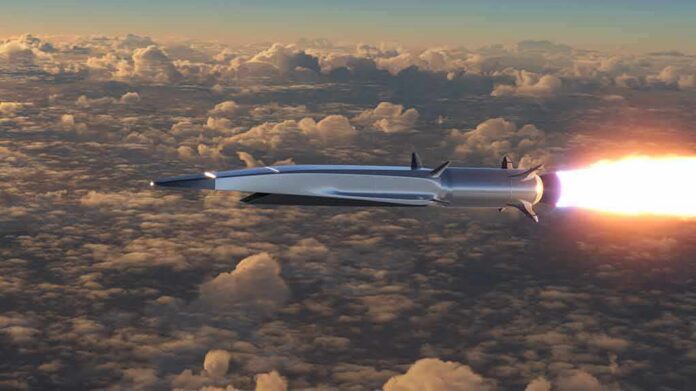
The U.S. Navy placed a production delivery order worth up to $200 million to push Castelion’s Blackbeard hypersonic missile from prototypes to fleet-ready rounds.
Story Highlights
- The Navy order moves Blackbeard from early prototypes to production weapons.
- Castelion cites a total value up to $200 million for this delivery order.
- Earlier Navy contracts advanced and integrated Blackbeard, building to this step.
- Reuters reported a separate $105 million Navy award tied to F/A-18 use.
Navy Order Transitions Blackbeard Into Production
Castelion announced the Navy issued a production delivery order with a total value up to $200 million to manufacture, assemble, test, and deliver an initial lot of Blackbeard hypersonic weapons. The company said the order transitions Blackbeard from early operational capability prototypes into production rounds under a Small Business Innovation Research Phase Three pathway. The announcement framed the action as a move from limited quantity to a scale fit for fleet use, marking a clear program shift toward operational delivery.
Castelion’s earlier Navy work set the stage for this production step. The company previously disclosed firm fixed price orders to advance Blackbeard toward early operational capability and to integrate the weapon for carrier operations. Those awards built manufacturing approaches, integration plans, and test articles to reduce risk before committing to a larger production lot. That sequence explains how a small defense firm can advance from prototypes to production under accelerated acquisition authorities in today’s threat environment.
How The Pentagon Uses SBIR Phase Three To Field Faster
Small Business Innovation Research Phase Three allows the government to fund production or services that extend prior small business work without using SBIR set-aside dollars. Phase Three can include test and evaluation or full production if the effort stems from earlier SBIR results. This pathway helps the Navy move promising tech to the fleet faster than the classic timeline, while keeping competition in mind for later, larger buys. That is exactly the mechanism described for Blackbeard’s transition.
Government watchdogs have warned that hypersonic programs face cost and schedule risks if leaders skip proven practices when using rapid pathways. The Government Accountability Office explains that middle tier acquisition speeds delivery by focusing on prototyping and early fielding, but it still requires solid engineering discipline. Clear milestones, user feedback, and test data are key to keeping programs on track as they scale. These best practices matter as Blackbeard shifts into production.
Where Blackbeard Fits In Navy Strike Plans
Reuters reported in April that the Navy awarded Castelion a $105 million contract to ready Blackbeard for use on carrier-based F/A-18 fighter jets. That report highlighted an air-launched role that can extend carrier reach and complicate enemy defenses. Today’s production order appears to build on that trajectory by funding actual production rounds after earlier integration steps. While the two awards have different amounts and aims, they point to a common push to make the weapon operational on Navy platforms.
🚀 The US Navy awarded @Castelion a production contract worth up to $200M for over 400 of its Blackbeard hypersonic missiles, which COO Sean Pitt told Tectonic was executed under the Navy's MACE program for integration with the F/A-18.
🔗 Full story from @barratt_dewey below pic.twitter.com/Sm0cfjliCZ
— Tectonic (@tectonicdefense) September 16, 2026
Cost pressure shapes every hypersonic discussion. The Congressional Budget Office has shown how traditional hypersonic boost-glide systems can be expensive across procurement and sustainment. That is why lower-cost, high-volume options draw attention, especially for carrier air wings that need magazine depth. If Blackbeard delivers credible range and speed at a lower price, the Navy could field larger numbers without breaking budgets. That value case will depend on production learning and test performance as deliveries begin.
What This Means For Readiness And Deterrence
The production order signals urgency to put more punch on the flight deck and to deter rivals who race to field similar weapons. Carrier-based hypersonic strike can hold key targets at risk from far away, reducing risk to crews and ships. Faster fielding under Phase Three can help close gaps without waiting years for traditional programs. As production starts, the focus turns to quality, on-time delivery, and safe integration so fleet squadrons can train and deploy with confidence.
Sources:
castelion.com, tipranks.com, reuters.com