When a single pipeline has the power to reroute a nation’s oil around the world’s most volatile chokepoint, its temporary loss is not a local incident — it is a stress test for global energy security and the market’s tolerance for geopolitical risk.
At a Glance
- Saudi Arabia temporarily shut its East–West Pipeline after multiple drone attacks triggered fires and injuries in the Riyadh and Madinah regions.
- Officials described the shutdown as a precaution; satellite imagery showed smoke and scorched ground near the site.
- Saudi authorities said the drones were launched from Iraq; Riyadh held off on retaliation to allow Baghdad to investigate.
- The East–West line is Saudi Arabia’s strategic bypass to the Strait of Hormuz; even short disruptions ripple through oil markets.
What happened: a targeted attack and a controlled shutdown
Saudi Arabia’s Ministry of Energy said it temporarily shut the kingdom’s East–West Pipeline following a series of drone attacks that struck in the Riyadh and Madinah regions, igniting fires and causing injuries to several people who received medical treatment. Authorities framed the move as a precaution to contain risk and allow damage control, not as a system collapse or catastrophic failure. The sequence was consistent across major outlets: attack, precautionary shutdown, and an investigation under way into launch origin. Commercial satellite images published soon after showed smoke and scorched ground near affected facilities, corroborating that a material incident occurred on the route.
Saudi officials said the drones were launched from Iraq; Riyadh publicly condemned the attack but opted against immediate retaliation at Baghdad’s request while Iraqi authorities conduct their own inquiry. That posture underscores the dual-track response Saudi Arabia now uses in infrastructure incidents: stabilize operations first, calibrate political and security responses second.
Why this line matters: the strategic “bypass” to Hormuz
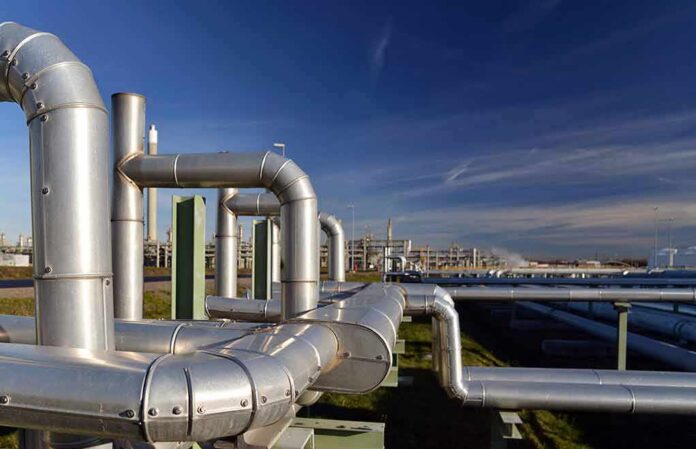
The East–West Pipeline, also known as Petroline, runs roughly 1,200 kilometers from Saudi Arabia’s eastern oil fields to the Red Sea export hub at Yanbu. Its strategic purpose is unambiguous: reduce dependence on the Strait of Hormuz, the narrow waterway through which a significant share of the world’s seaborne crude typically moves. When Hormuz is threatened — by state confrontation or proxy harassment — the East–West route preserves Saudi export optionality and market steadiness. Analysts routinely describe it as a lifeline or safety valve; that is why attacks on this system, even when damage is contained and outages brief, tend to move prices and trading behavior beyond what the physical loss alone would justify.
Capacity figures for Petroline vary in public reporting because they mix design limits, pre-war baselines, and current throughput, but the strategic logic does not: the line can shift a large volume of Saudi crude away from Hormuz during maritime crises. That leverage is precisely what makes it a high-value target for state and non-state actors who seek influence over Gulf energy flows without engaging in a direct naval confrontation.
How the market interpreted the risk
Oil traders do not need a prolonged outage to reprice risk; they need credible evidence that a key redundancy is vulnerable. The attack delivered that signal. Prices rose on headlines as participants marked up geopolitical risk premia and recalibrated for potential export bottlenecks if repairs, inspections, or follow-on attacks restricted flows longer than initial statements implied. The dynamic is familiar from prior Gulf disruption episodes: even when physical balances are adequate, the probability distribution around future supply widens, and options markets, differentials, and freight rates reflect that uncertainty.
Because Saudi statements emphasized a precautionary shutdown and because Riyadh refrained from immediate kinetic response, market anxiety centered on operational recovery timelines and the possibility of escalation, not on a near-term loss of millions of barrels per day. That distinction matters: it is the difference between a structural supply shock and a risk premium spike that fades if the line restarts cleanly and deterrence holds.
Attribution and the pattern of Gulf energy coercion
Saudi authorities stated the drones came from Iraq; at the same time, early public reporting did not name a perpetrator with forensic specificity. That gap between operational clarity and definitive attribution is common in the region and often becomes the political battleground after the firefighting ends. It also fits a broader trend in which adversaries target infrastructure that is both economically consequential and symbolically resonant, accepting that even minor physical damage can deliver outsize strategic messaging and market impact.
In recent years, actors operating from Yemen and Iraq have repeatedly demonstrated the ability to strike beyond front lines and test layered air defenses with low-cost, low-observable drones and munitions. The East–West line’s pumped segments, power supplies, and control systems — not just the buried pipe — present discrete nodes where small explosions can trigger protective shutdowns. That technical reality gives attackers leverage: they do not need to breach the steel artery itself to force an interruption that grabs global attention.
Operational mechanics: why “precaution” is the right word
Pipeline operators design for containment. When sensors detect pressure anomalies, fire, or physical intrusion near pumping stations, automated and human-in-the-loop protocols reduce flow, isolate segments with block valves, and depressurize to protect personnel and equipment. Declaring a temporary shutdown while emergency teams extinguish fires and assess station integrity is standard practice in high-reliability operations. It shortens the path to safe restart because it prevents secondary damage — the costly kind that cascades when systems keep running through uncertain conditions. Saudi officials’ emphasis on precaution signals the line’s core remained intact and the response prioritized controlled verification over haste.
Satellite-observed smoke plumes near Medina are consistent with fires at or adjacent to above-ground installations rather than along long-haul buried stretches. That matters for repair timelines: pumping equipment, electrical systems, and auxiliaries can be swapped or patched faster than excavating, replacing, and pressure-testing lengthy pipe sections. It also means insurance adjusters and underwriters will look closely at station hardening and fire suppression performance, since those systems largely determine whether a station fire is an hours-long disruption or a multi-week outage.
Policy choices: restraint, investigation, and deterrence
Riyadh’s decision to hold off retaliation while Iraq investigates reflects a deliberate phase in Saudi crisis management: preserve escalation control, shore up legitimacy by coordinating with a neighbor, and allow technical investigators to build an evidentiary chain that can support diplomatic or military measures if required. It is not passivity; it is sequencing — operational recovery, then attribution-backed consequence. That approach also acknowledges that Saudi Arabia’s energy security is now interdependent with partners’ internal security; launch sites, material supply chains, and command nodes often sit across borders.
The strategic objective is straightforward: reestablish deterrence without inviting a tit-for-tat cycle that keeps the pipeline within a weekly target set. That requires visible improvements to point defense around pumping stations, better counter‑UAS coverage along approach corridors, and resilience upgrades — from redundant power and control to rapid-swap spares — that turn a successful strike into a short outage rather than a market-shaking event.
Oil prices up over 3% following new strikes on Saudi ~
-> East-West pipeline shutdown threatens up to 4% of global oil supply
-> Gulf-Iran meeting on Strait of Hormuz postponed – Oman pic.twitter.com/GD3n2OFJ2A— 0x_kael (@0x_kael) September 14, 2026
What to watch next: signals of recovery and resilience
Three markers will tell the story from here. First, the speed and scope of restart: partial versus full resumption indicates whether damage was confined to discrete stations or required broader system checks. Second, the diplomatic lane: the content and timing of Iraq’s findings will shape Saudi messaging on accountability and any multilateral moves. Third, the engineering after-action: visible hardening at Yanbu and inland stations — additional counter‑drone sensors, barriers, and fire systems — is the practical deterrent markets reward because it shortens and de-risks the next recovery. Together, those signals determine whether this incident remains a price blip or becomes a template for repeated coercion.
Sources:
feedpress.me, bbc.com, thenationalnews.com, pbs.org, argusmedia.com, nytimes.com, reuters.com