
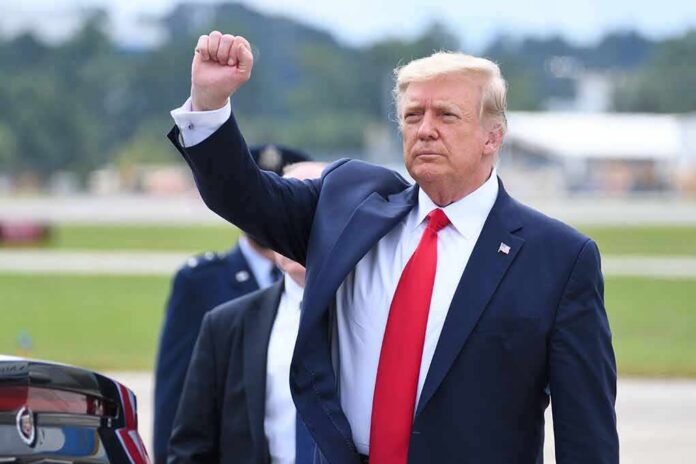
President Trump publicly urged Democratic Senator John Fetterman to join the Republican Party, praising his “common sense” and saying he’d “love” to have him on the GOP side.
Story Highlights
- Trump said he would “love” Fetterman as a Republican and praised his judgment.
- Fetterman recently addressed a Republican convention by video and backed a GOP Senate candidate.
- Trump claimed polls show Fetterman fares better as a Republican, without naming a specific poll.
- Fetterman still identifies as a Democrat and has denied plans to switch parties.
Trump’s Pitch To Fetterman And What He Said
President Trump told reporters at Joint Base Andrews on October 10, 2026, that he wants Senator John Fetterman to switch parties. Trump said, “I’d love to see him as a Republican” and called Fetterman a “great guy” with “great common sense.” He added that he would “love to have him as a Republican.” These remarks confirmed on-the-record outreach from the president to a sitting Democratic senator from Pennsylvania.
Trump also argued that Fetterman could do better with voters as a Republican. He said polling supports that case, though the coverage did not cite a specific survey or results. That claim framed the move as both personal praise and electoral math. The timing, weeks before midterm voting, underscored how party identity and control of Congress are central to the pitch and to the stakes for both parties this fall.
Why Fetterman Is In The Spotlight Right Now
Senator Fetterman drew attention in September by appearing via video at a Republican midterm convention. He introduced Republican Senator Dave McCormick, called him “a great American,” and said he would work with President Trump to defend steel jobs. The video set off talk about a possible party switch. But in the same period, Fetterman described himself as a “common-sense Democrat,” which kept his public label intact.
Fetterman’s cross-party message fits a pattern where senators highlight shared goals on jobs, trade, or security while keeping distance from party fights. That can appeal to voters who want results over rhetoric. It also can agitate party activists who see loyalty tests as proof of values. This is why one convention video can become a litmus test, even if the senator’s formal affiliation and voting record have not changed.
What Is Known, What Is Not, And Why It Matters
The facts are straightforward: Trump urged Fetterman to join the GOP and praised him by name. Fetterman spoke to a GOP event by video and voiced support for a Republican candidate and for working with Trump on steel. Fetterman has not announced a party switch and has pushed back on switching talk. Those points set the boundary between real events and speculation about future moves.
🚨 JUST IN: President Trump is OPENLY ENCOURAGING Sen. John Fetterman (D-PA) to SWITCH PARTIES and join the Republicans!
Trump said:
“I’d LOVE to have him as a Republican. John Fetterman is a great guy with magnificent parents!”
“He does better as a Republican than he does as… pic.twitter.com/f0BS2vzALy
— NanceMace (@Nancymace55) October 11, 2026
Party switching in the Senate is rare but not new. Over the last century, several senators have changed parties while in office, often tying the move to principle, pressure from voters, or electoral survival. These shifts can change committee power and reshape close votes. That history helps explain why one senator’s choice can feel larger than one state. It can tilt national debates on spending, energy, immigration, and foreign policy.
How This Touches Voter Frustration On Both Sides
Voters across the spectrum see leaders chasing advantage instead of fixing costs, crime, and border issues. Trump’s invite to Fetterman speaks to that mood. It rewards blunt talk and a focus on jobs. It also shows how party brands flex when power is on the line. Some conservatives cheer a bigger coalition on steel and trade. Some liberals bristle at praise for Trump. Many others ask whether any switch would deliver real results in their daily lives.
What To Watch Next In Pennsylvania And Washington
Watch for any formal step by Fetterman, such as a change to his Senate caucus choice or a filing with party groups. Look for whether Republican leaders in Washington or in Pennsylvania open doors on committees or a future ballot path. Keep an eye on how Fetterman votes on labor, energy, immigration, and Israel policy. Those roll calls will show whether the talk becomes a broader bond or remains selective teamwork on a few high-salience issues.
Sources:
nypost.com, foxnews.com, yahoo.com, usnews.com, aljazeera.com, politico.com