
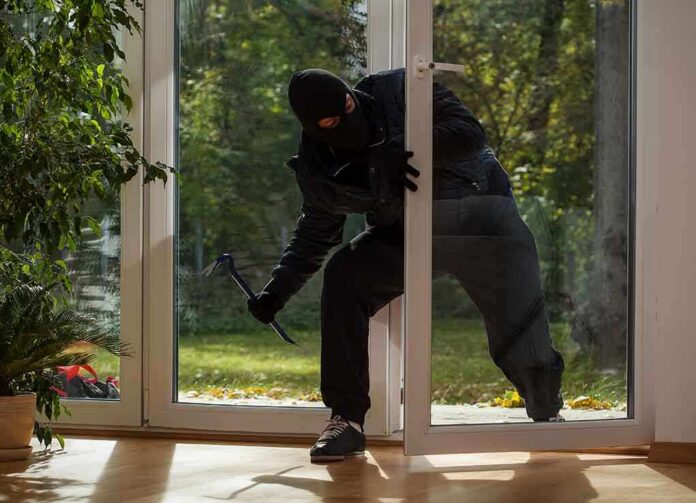
The line between odd and unlawful is not where many people think it is; doorbell cameras now capture a flood of ambiguous doorstep encounters, and police responses increasingly hinge on intent, risk of escalation, and the absence of an actual offense, not on how unsettling a clip looks online.
At a Glance
- Watauga, Texas police reviewed a homeowner’s doorbell video of a masked visitor and determined no criminal offense occurred.
- The conduct was unusual—touching the camera, eating a banana through a Joe Biden mask—but did not establish an identified suspect, criminal intent, or a completed crime.
- Officers searched the area but did not locate the person; no arrest or charges followed.
- Police warned that stunts perceived as threatening can provoke dangerous confrontations and urged residents to call authorities rather than engage directly.
What Happened and Why Police Called It “No Crime”
On the evening of October 18, Watauga police responded to a suspicious-activity call after a doorbell camera recorded an unidentified, barefoot person wearing a Joe Biden mask and a shirt printed with “FREEDOM.” The video shows the individual approach the door, touch the Nest camera twice, and eat a banana through the mask before leaving. Officers reviewed the recording at the scene, canvassed the neighborhood, and reported finding no evidence of a criminal offense; the individual was not located, and no charges were filed. The department coupled that determination with a safety advisory: behavior that appears threatening can trigger confrontations and cause serious injury, so residents should contact police rather than intervene themselves.
The core of the no-crime assessment is straightforward. Odd behavior alone does not establish criminal intent or a statutory violation. Without attempted entry, property damage, explicit threats, or a pattern of harassment, a single, brief presence on a front stoop often falls short of trespass or disorderly conduct under state and local law. Multiple outlets described the same sequence and attributed the department’s determination to Watauga Police, underscoring that this was a routine, if peculiar, suspicious-activity call resolved without arrest.
How Departments Weigh Doorstep Encounters Captured on Camera
Modern patrol decision-making draws a clear distinction between conduct that is unusual, disturbing, or socially transgressive and conduct that meets statutory elements for a crime. For a trespass, prosecutors typically need notice against entry or refusal to depart; for harassment, a course of conduct or explicit threat; for disorderly conduct, behavior likely to provoke an immediate breach of the peace. A single approach, silent, without damage or threat, often sits in a gray zone that warrants a response and documentation—but not handcuffs. Police are also trained to consider risk of escalation: if a homeowner confronts someone while armed or agitated, a prank or stunt can become a use-of-force encounter. That is why agencies routinely advise residents to call 911, turn on exterior lights, and avoid opening the door to unknown visitors when the only “evidence” of danger is a strange clip.
In the Watauga case, the available record supports that framework. Officers viewed the video, saw no offense in progress or completed, searched for the subject, and closed the call without charges. The warning they issued goes to the real hazard in these situations: perception. Behavior that is merely odd on video can feel threatening in person, and a face covering or political costume can amplify that perception—raising the stakes for everyone on the porch and beyond.
Why These Clips Travel So Far—and Why That Matters
Doorbell cameras have multiplied the number of doorstep interactions that become shareable artifacts. Neighborhood apps and social platforms often label subjects as “suspicious” or “criminal” based on appearance and vibe rather than legal criteria. Research on consumer surveillance and neighborhood feeds shows how these systems encourage rapid circulation of ambiguous footage and can prime residents to interpret innocuous acts as threats, especially when contextual details are thin. The technology is helpful—package thefts are real, and video can solve crimes—but it also shifts the baseline: more encounters are documented, more are posted, and more are judged in public before police make a legal assessment.
This amplification loop is why departments increasingly pair no-crime findings with practical guidance. A clip that looks “off” can draw hundreds of comments, calls for vigilante identification, and pressure on police to “do something,” even when statutes don’t fit. Advisories that explain the difference between unsettling and unlawful, and that emphasize calling authorities rather than confronting visitors, are meant to keep neighbors safe while preserving investigative discretion. Put differently: public safety depends as much on managing our reactions to ambiguous footage as on catching actual offenders.
The Legal Gray Zone: Odd, Offensive, or Unlawful?
Ambiguous doorstep behavior forces a careful, element-by-element review. Property crimes typically require damage or deprivation; violent crimes require force, threat, or credible fear tied to specific acts; public-order offenses hinge on likelihood of a breach of peace. A single masked appearance, absent words or actions that cross those thresholds, often remains noncriminal. If the same person returns repeatedly after warnings, tampers with fixtures, leaves substances or litter, or utters threats, the calculus changes quickly. Frequency, context, and demonstrable harm matter because they transform an oddity into a pattern—legally relevant conduct with clearer statutory hooks. In this incident, based on contemporaneous reporting and the department’s account, those aggravators were not present.
There is also a human-factors dimension. Under stress or anger, people are more likely to misread innocuous cues as threats; this is why police and safety educators emphasize de-escalation and physical standoff distance when someone unknown approaches a residence. Technology does not eliminate that bias—it can magnify it by supplying a replayable image divorced from context. That puts a premium on posture: keep the door closed, use intercom features, call police if you feel unsafe, and let trained responders test the situation against the law rather than emotion.
Practical Guidance for Homeowners
When a clip captures odd conduct, treat it as a safety problem first, a social-media object never, and a legal question only after police assess it. Turn on exterior lights; use your doorbell’s audio to communicate without opening the door; call non-emergency or 911 based on immediacy and your level of concern; and preserve the original video export for officers. Resist posting identifiable footage to neighborhood feeds until police advise—public identification campaigns can endanger bystanders and complicate investigations. If patterns emerge—repeated late-night approaches, tampering, written messages—document times and outcomes; patterns, not single moments, often determine whether a statute applies.
Finally, remember why departments issue warnings even after saying “no crime.” The absence of a charge today does not guarantee safety tomorrow; the point is to prevent a needless confrontation from becoming the most dangerous thing that happens on your block. In Watauga, police closed a peculiar call without finding an offense and reminded residents to let trained responders adjudicate the next one. That’s not hedging; it is the operational logic of public safety in an era when every doorstep is a camera and every clip can go viral.
Sources:
foxnews.com, noticias.foxnews.com, m.dailyadvent.com, yahoo.com, vice.com, abc17news.com, eff.org