When large French demonstrations turn volatile, the state does not improvise; it reaches for a well-honed public-order playbook that concentrates specialized riot units at flashpoints, imposes time-and-place restrictions, and scales force rapidly when initial controls falter.
At a Glance
- Paris saw a heavy, visibly mobile police presence, with tear gas deployed amid clashes and looting risks during a third consecutive protest weekend.
- The Paris prefecture activated CRS 8 and other rapid-response units, concentrating on Les Halles and other hubs to preempt ransacking and restore calm.
- Authorities coupled deployments with targeted curfews and protest bans around Place de la République and Les Halles, enforced by on-the-ground police.
- After acknowledging they had underestimated the previous weekend’s unrest, the Interior Ministry expanded the operation to 70,000 police and gendarmes nationwide.
What Happened: Concentrated deployments, moving flashpoints, and curfews
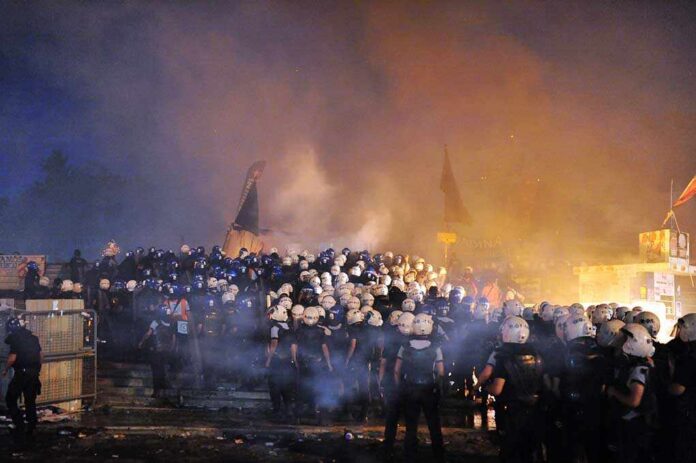
Across a third weekend of demonstrations in Paris, authorities fielded a conspicuous, large-scale security operation designed for mobility and fast intervention. Police massed near high-value and symbolically charged areas—around the Champs-Élysées, the Arc de Triomphe, and transit and shopping nodes—where the risk of opportunistic ransacking rises as night falls and crowds splinter. Clashes did occur; police used tear gas in central Paris and engaged groups that sought confrontation. This was not a static line-holding posture. The prefecture emphasized an agile approach anticipating highly mobile processions and dispatched the elite CRS 8 unit to Les Halles to disrupt incipient looting and reassert control block by block.
Law-and-order tools extended beyond formations and grenadiers. Prefectural orders barred demonstrations in defined zones from 8 p.m., and an overnight curfew from 11 p.m. to 6 a.m. covered gathering points such as Place de la République and Les Halles. The police framed these as narrow, time-bound measures targeted for effect, with explicit instruction that deployments “ensure strict compliance” on the ground. These restrictions are not decorative; they change the geometry of protest, making it harder for hardline groups to fuse with otherwise peaceful columns after dark, when vandalism and attacks typically spike.
Scale and escalation: From underestimation to surge capacity
France’s interior ministry conceded it misjudged the intensity of the earlier weekend’s unrest, when 60,000 personnel could not fully contain violence in several cities. The response was immediate and measurable: authorities surged to 70,000 police and gendarmes nationwide for the subsequent weekend, a 10,000-officer increase aimed at saturating transit nodes, protecting commercial corridors, and hardening municipal buildings repeatedly targeted during similar cycles of protest-turned-riot. That surge logic reflects an explicit doctrine articulated by Interior Minister Laurent Nunez—“uncompromising” toward rioters and looters—backed by the density of units required to separate peaceful marchers from those intent on confrontation.
This scale-up sits on a simple operational truth: once violence has breached storefronts and city halls, deterrence requires visible mass and rapid interdiction. Reuters reporting cataloged the pattern—running clashes, tear gas in Paris, and vandalism and assaults on public buildings and police in Marseille and other cities—providing the predicate for the larger security footprint. The authorities’ admission of underestimation is not exculpatory; it is part of the factual record of why the state recalibrated force levels and tactics a week later.
How French public-order policing works: Design, doctrine, and trade-offs
French protest policing is built around permanent, professional public-order units—the Compagnies Républicaines de Sécurité (CRS) and the mobile gendarmerie—whose core mission is crowd control at scale. Historically, French doctrine has emphasized controlling crowds from standoff distances with formations, cordons, and area denial tools, supplemented by graduated force and “less-lethal” munitions designed to disperse rather than incapacitate. In the modern urban core, that distance has compressed; protests are more dynamic, black bloc tactics are more agile, and the city’s topology of transit hubs and retail arcades creates many exploitable choke points. Specialized teams like CRS 8 exist precisely to move quickly within that environment—short, sharp interventions to break up attempts at ransacking or to peel violent actors off a peaceful march.
France’s arsenal and posture are more muscular than many European counterparts—by design. The country’s layered history of contentious assemblies, from 1968 to the Yellow Vests to pension reform protests, entrenched a model where the state seeks to manage disorder at scale while preserving the capacity to reestablish control decisively if flashpoints cascade. That design carries trade-offs. Highly visible riot units and tear gas can signal order; they can also become the protest’s defining visual grammar, even when most demonstrators are peaceful. In Paris, both realities often coexist in the same hour: largely calm processions that later fracture at the margins, and swift riot-police pushes that stop a ransacking—at the cost of images that dominate the night’s coverage.
A protest in Paris took a terrifying turn on October 31. 🇫🇷
During clashes near Porte de Charenton, Molotov cocktails were thrown at police officers, setting some of their protective gear on fire.
French authorities confirmed five officers were injured, including three who… pic.twitter.com/UWLhIxTAeP
— Kimmes (@kimmesspl) November 2, 2026
Where the disagreement actually lies: Policing aims versus public reception
On paper and in the field, the state made two linked assertions: that time-and-place bans and curfews around République and Les Halles were justified by credible risks, and that concentrated, mobile deployments would limit violence. The public record affirms the measures and the deployments. It also shows clashes in Paris despite them, and government acknowledgment that the initial posture was insufficient. Those facts do not negate the logic of the approach; they clarify its limits when protest cycles accelerate and violent actors adapt. The Interior Ministry’s rhetoric has also assigned blame to the “ultra-left,” a label that hardens political readings of events that authorities frame as operational necessity. That contest over narrative is perennial in France, where protest is a civic rite and crowd-control is a permanent state craft.
Why it matters: Governance, liberty, and the Paris template
Paris is the country’s proving ground for public-order doctrine; how the capital is managed becomes the template exported to prefectures nationwide. The combination on display—mass deployment, agile riot units at retail and transit hubs, and narrowly drawn curfews—reflects a state seeking to keep the night’s worst impulses contained while honoring the day’s right to assemble. It is a difficult balance, and not uniformly successful. But the structure is legible: anticipate mobility, cut the fuse points after dark, and be prepared to surge when the previous weekend’s baseline fails. Expect it to recur whenever French protests ride the line between mass grievance and opportunistic violence—and to remain controversial precisely because it is visible, forceful, and decisive enough to leave a mark on both the streets and the public imagination.