
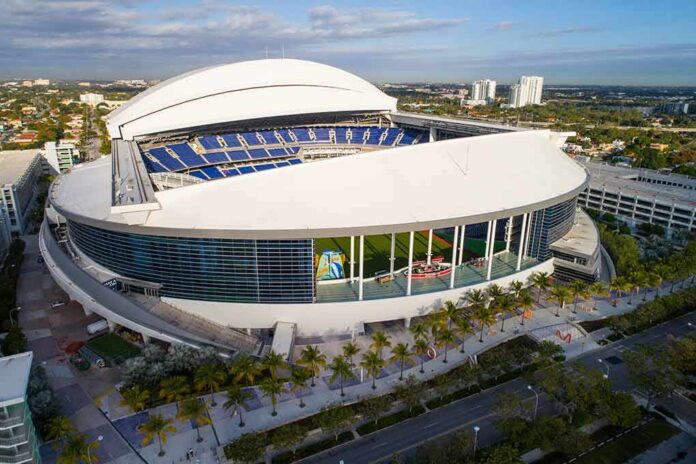
The case for pouring public money into pro-sports venues lives and dies on one question: how much of the spending they generate is truly new to a region, rather than dollars rearranged from elsewhere in town. Jacksonville’s $1.4 billion EverBank Stadium overhaul—backed by $775 million in city commitments—puts that question in unusually sharp relief because the near-term costs are certain and the headline benefits are decades-long forecasts.
The Short Version
- Jacksonville approved a $1.4 billion renovation of EverBank Stadium, splitting core construction 50/50 with the Jaguars and adding $150 million in city maintenance and prep, for a public total of $775 million.
- Construction reduces capacity in 2026 and moves all Jaguars home games to Orlando in 2027; the renovated stadium targets reopening for the 2028 season.
- A Jaguars-commissioned study projects roughly $21.7–26 billion in long-run economic impact; independent economists broadly dispute such magnitudes and the premise that stadiums deliver large net-new gains.
- The lease includes a non-relocation commitment aimed at keeping the franchise in Jacksonville for 30 years, anchoring civic value beyond game days.
What Jacksonville Actually Bought: Structure, Term, and a Construction Gap
Jacksonville’s arrangement is not a speculative concept; it is a signed, appropriated public-private project with a clear calendar and a long-term lease spine. The City Council approved the agreement by a lopsided vote, committing $625 million toward construction and a separate $150 million for maintenance and preparatory work, while the Jaguars and owner Shad Khan fund $625 million of construction—placing the city’s total at $775 million and just over half the capital stack. The project proceeds in phases, constricting capacity in 2026 and shifting the club’s entire 2027 home slate to Camping World Stadium in Orlando under NFL-approved terms before returning to a renovated EverBank in 2028. These are tangible, dated commitments, and they define the trade: near-term disruption for a multi-decade tenancy platform.
The lease architecture matters. Stadium financing battles often devolve into abstractions about “impact,” but the most concrete local benefit is franchise retention—codified here through a non-relocation clause described as securing the team for 30 years. That covenant anchors the region’s NFL identity and its recurring calendar of events; it is not a fiscal return by itself, but it is the intertemporal guarantee without which any modeled benefits evaporate.
The Economic Case: Big Numbers, Familiar Frictions
On paper, the upside is enormous. A Jaguars-commissioned Tourism Economics analysis projects roughly $21.7 billion in impact from 2028 through 2052, including $10.3 billion of direct spending and the rest from supplier (indirect) and employee (induced) effects, plus a separate construction-phase boost. In practice, two frictions recur. First, the model is not public in full detail; without its multipliers, displacement and leakage assumptions, or sensitivity analysis, the 30-year figure is an opaque headline rather than a testable forecast. Second, the study’s near-term attendance scaffolding has conflicts—counting events scheduled elsewhere and presuming Jaguars home dates in years when the team will be playing in Orlando—undermining confidence in the early ramp that feeds the compounding math.
Those shortcomings are not unique to Jacksonville. They track the national literature’s base rate: independent economists have, for decades, found that stadiums rarely move metro employment, income, or tax receipts in ways commensurate with public cost. The core mechanism critique is straightforward. Substitution effects shift local leisure dollars from one venue to another; leakage moves high-salary income to where players and owners actually live; and budget costs crowd out alternate public investments with higher returns. A comprehensive 2023 survey characterizes the field’s consensus as “very limited economic impacts,” even when conceding softer benefits like civic pride.
Independent Evidence: What We Know vs. What We Want to Believe
Against promoter studies, the independent bench is stark. Economists such as Victor Matheson and J.C. Bradbury have repeatedly concluded that publicly funded venues produce negligible to very small net gains at the city level. Local reporting shows Jacksonville has historically spent materially more to operate the stadium than it collected in stadium-specific revenues—over $87 million in expenses versus $20.6 million in revenues across four recent fiscal years, a net outflow that contextualizes the ongoing carry cost for taxpayers even before renovation debt service or capital is considered. Meta-reviews of 100-plus studies echo the same refrain: direct benefits tend to be modest and mismatched to the subsidy scale.
There are exceptions and nuances—a few settings show localized taxable sales gains around new ballparks, or neighborhood-level effects distinct from metro aggregates—but the weight of evidence suggests the typical stadium’s measurable, net-new economic lift is small relative to the subsidy. That doesn’t make the Jaguars deal irrational; it places the burden of proof where it belongs: on transparent models, verifiable event pipelines, and ongoing disclosures that separate aspiration from realized outcomes.
Mechanics That Will Decide Whether Jacksonville Beats the Base Rate
Several design and contract features could tilt realized value upward if executed cleanly. First, event capacity and weather mitigation—the canopy, concourse circulation, and heat management—directly influence the feasible calendar for large non-NFL events in Florida’s climate. If those physical upgrades translate into a materially larger, higher-spend event portfolio—think neutral-site football games, large concerts, or marquee events that previously bypassed Jacksonville—some portion of spending can be credibly net-new rather than displaced. Second, lease terms on cost overruns, revenue splits, and operations determine whether incremental activity accrues to the public ledger or is captured by the team’s P&L; the claim that the club bears overruns is economically material if borne out in the executed documents.
Third, scheduling integrity matters. The 2027 season in Orlando is not merely a nuisance; it creates a one-year diversion of fan spending to another metro, and it exposes the city to narrative risk if announced events in the model do not materialize upon reopening. That is precisely where official verification can strengthen the case: publish a credible booking pipeline, reconcile counted events with signed LOIs, and, once the stadium reopens, show year-over-year tax receipts in hospitality categories tied to event weeks versus baseline.
Accountability Architecture: How to Turn a Forecast into a Scorecard
The difference between an “impact” number and a civic investment case is measurement. Jacksonville can convert a contested projection into an auditable program by doing four things. One, release the full economic model—assumptions, multipliers, displacement, leakage, and sensitivity cases—so independent analysts can replicate and stress-test it. Two, commission an external net-impact study against a no-renovation counterfactual; house it with the Council Auditor or a state university and publish methods and code. Three, disclose the executed agreement set—lease, development agreement, non-relocation covenant, cost-overrun treatment, event-revenue splits, maintenance obligations—and calendar a public briefing before each construction phase to update costs and timelines. Four, commit to annual post-reopening reporting: attendance, event count, hotel and sales taxes on event weeks, stadium O&M costs, public debt service, and team-related payroll sourced locally.
None of these steps guarantees a surplus, but each shrinks the gap between rhetoric and reality. Given the base rate of stadium projects, skepticism is earned; the antidote isn’t better slogans, it is better data.
City’s contribution:
$775 million toward stadium construction.
$150 million to make the venue usable for two seasons while construction is underway.
$56 million for riverfront parks and improvements to the stadium‑adjacent flex field.Team’s contribution: $625 million…
— Catherine Evermore™ (@CatherineUSA1) November 1, 2026
What It Means For Jacksonville
The city has secured its NFL franchise for a generation and will soon possess a climate-adapted venue better suited to host large events in a hot, humid market. Those are real assets. The public cost—upfront capital, operating exposure, and a lost home season—arrives first, while the modeled benefits stretch across three decades. Independent evidence argues the typical metro underperforms the booster math. Jacksonville’s path to beating that average runs through execution: finish on time, build a bookable building, land events that truly wouldn’t have come otherwise, and prove it on the ledger.
Sources:
reason.com, jaguars.com, insider.espn.com, visitjacksonville.com, jacksonville.com, jaxdailyrecord.com, actionnewsjax.com