
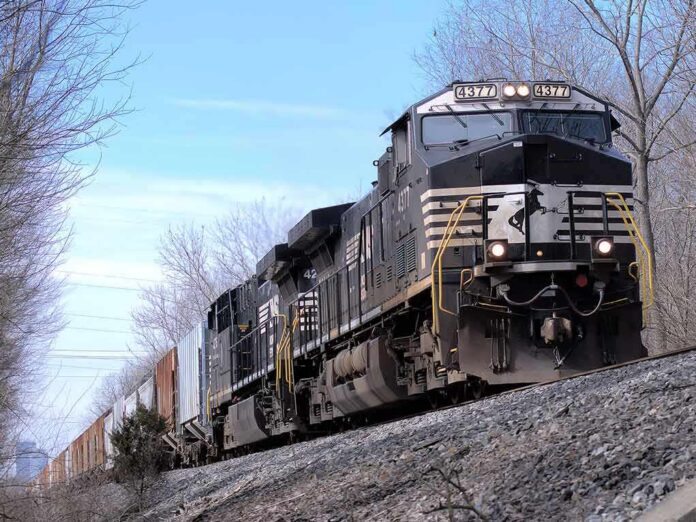
Breaking a freight train is not just theft; it is systems sabotage. The Southern California case federal prosecutors brought forward alleges a crew that treated the supply chain like a programmable machine—forcing trains to stop, breaching containers at speed, and moving goods through a ready resale network—demonstrating how modern cargo crime operates as organized enterprise, not opportunistic looting.
At a Glance
- Federal prosecutors charged 14 defendants in a 17-count indictment alleging a coordinated cargo-theft ring that hit at least three dozen trains and stole more than $22 million in goods.
- Authorities describe a repeatable method: cut air hoses to trigger emergency stops, breach containers, and offload high-value merchandise to stash locations and black-market buyers.
- Investigators point to video, images, and social media communications tying individuals to specific thefts and resale channels.
- The alleged scheme fits a national pattern: cargo theft is organized, commercially motivated, and difficult to measure with precision.
An alleged train-burglary ring built for repetition, not spectacle
According to the Justice Department, a federal grand jury returned a 17-count indictment charging 14 defendants with conspiracy and multiple counts tied to the theft and receipt of stolen interstate railroad cargo, plus violence against railroad carriers. Prosecutors allege the group burglarized at least three dozen trains over roughly two and a half years, removing more than $22 million in consumer goods—prominently Nike footwear and Milwaukee-branded tools—and selling them on the black market. The case is presented not as episodic mischief but as a coordinated operation with defined roles, logistics, and resale infrastructure, the hallmarks of organized cargo crime.
Authorities identify 21-year-old Nathan Daniel Angel of East Los Angeles as the alleged organizer, describing a network that included relatives and associates handling scouting, transport, and distribution. The charged conduct centers on a repeatable disabling technique: cutting the air-brake hoses or train lines to trigger an emergency stop, then breaching intermodal containers and funneling merchandise to vehicles positioned nearby. Local law enforcement, citing the same pattern across many incidents, underscore the public-safety risk of interfering with heavy freight equipment in motion.
How the method works: air, steel, timing, and a ready market
Freight trains rely on a continuous air-brake system; disrupting the line induces an emergency application that halts the consist. Investigators allege the crew exploited that principle in remote stretches, where forced stops buy time. Teams then targeted specific containers—often high-value soft goods and tools—sawed through doors or locks, and transferred cartons rapidly to waiting trucks or vans. From there, goods moved to stash houses and warehouses, then into resale channels where counterfeit provenance is masked by volume, cash transactions, and fragmented handling.
Prosecutors and local reporting describe a digital trail that maps onto the physical one. Messaging applications allegedly coordinated crews and buyers; images recovered from cloud accounts and phones purport to show stacks of branded cartons in warehouses, suspects handling cash, and even footage of a burglar cutting locks on a moving train. One report describes images from a defendant’s iCloud and video of a suspect sawing into a container, which—if authenticated in court—would tie named individuals to particular loads and locations. The indictment also alleges the goods were marketed to black-market buyers, including sneaker resellers, reinforcing that theft and resale are two halves of a single operation.
Scale and stakes: why this case commands attention
The alleged losses exceed $22 million across more than 70 containers, a volume that puts the case among the largest train-cargo theft prosecutions in the region. Beyond dollar figures, the disruption touches manufacturers, shippers, insurers, retailers, and consumers—most of whom feel the losses indirectly through inventory distortion and cost recovery across a supply chain optimized for speed, not courtroom-grade custody. The image of thieves breaching containers from moving trains reads cinematic, but the underlying mechanics are sober: a vulnerability in brake continuity, geography that allows quick exfiltration, and a resale market primed by brand scarcity and cash liquidity.
One reason such rings can persist is measurement. Cargo theft as tracked by law enforcement spans railcars, trucks, intermodal yards, and warehouses; reporting is fragmented across agencies and private loss registries. The FBI’s cargo-theft category recognizes that these offenses frequently sit within larger criminal schemes, but national data remain incomplete; local reporting is not mandatory, and private databases guard client detail. When analysts or lawmakers cite “surges,” they are often triangulating from imperfect denominators and industry samples. This case, regardless of its final adjudication, reflects how organized theft exploits that opacity.
What the charging documents and public accounts establish
The government’s theory rests on four concrete planks. First, structure: a conspiracy count that asserts planning and division of labor across 14 defendants. Second, method: repeated disabling of trains via cut air lines or hoses, with container breaches during or after forced stops. Third, evidence: video and images said to capture entries into moving trains, stash-house inventories, and cash thought to be proceeds. Fourth, monetization: black-market resale of athletic footwear, apparel, and tools, allegedly brokered in part through social media connections. Prosecutors place Angel at the hub of these spokes, while local police identify family ties among several participants—an arrangement common in long-running property crimes where trust is operational currency.
Public accounts also supply granularity on the targets: one cited example describes thousands of pairs of Nike sneakers from a single shipment, and other loads included power tools popular in both legitimate and illicit secondary markets. Intermodal rail, which consolidates high-value consumer goods into containers moving long distances, offers thieves a favorable ratio of payoff to time—especially when they can force stops away from yards with cameras and guards.
Where this fits in the national cargo-theft landscape
Rail is one leg of a larger problem set that spans trucks, ports, and warehouses. The FBI’s guidance frames cargo theft as an element of organized crime—less smash-and-grab, more supply-chain arbitrage with criminal logistics. Because reporting is inconsistent, comprehensive comparisons are elusive; a single, well-run ring can account for a disproportionate share of losses within a region and time period. What distinguishes the Southern California case is not only the alleged dollar value but the operational clarity: a defined train-stopping technique, evidence of planning captured on devices, and a distribution network that appears to have moved goods at scale.
For shippers and carriers, the practical lessons are concrete. Harden the brake-line environment where feasible; pair locomotive event data with right-of-way surveillance to flag anomalous stops; geo-fence high-risk corridors for quicker response; and pressure-test outbound channels where stolen goods predictably surface. For brands and retailers, proactive monitoring of gray-market inventory—especially high-heat SKUs in footwear and tools—can tighten the window in which stolen goods convert to cash.
"The scale of the theft is staggering. We have charged a crew of 14 in a scheme to steal more than $22.5 million in cargo from at least three dozen freight trains in Southern California," said U.S. Attorney Bill Essayli in a statement. https://t.co/KWLYreGPIT
— CBS News Texas (@CBSNewsTexas) November 23, 2026
What to watch next
As the case proceeds, expect attention on defendant-specific acts and the provenance of digital evidence—the linkage between devices, accounts, and locations that translates storyboards into admissible proof. For the broader market, the immediate implication is simpler: supply-chain security is a systems problem. Rings succeed when they can force predictable exceptions—unscheduled stops, unmonitored transfer points—and monetize quickly through buyers trained to ignore questions. Disrupt any one link, and the math shifts. Disrupt two, and most rings collapse under their own logistics.
Sources:
patch.com, lapdonline.org, abc7chicago.com, nbcbayarea.com, washingtonpost.com, freep.com, foxla.com, freightwaves.com