
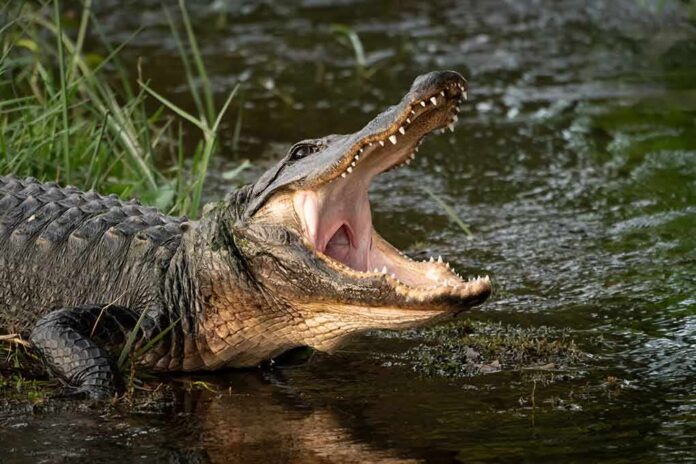
A 71-year-old fisherman died Friday after a 12-foot alligator dragged him into a Florida lake, and it took rescuers two hours to recover his body because other gators kept circling the scene.
Story Snapshot
- Steven Hamilton, 71, was attacked while standing on the shoreline near Dr. Bradford Memorial Park in Winter Garden, Florida, around 5 p.m.
- Police say a nearly 12-foot alligator was behind the attack, and wildlife trappers later caught and killed an animal measuring 11 feet, 8 inches.
- The medical examiner ruled Hamilton died from severe leg injuries and drowning, calling it an accident.
- Other active alligators in the water slowed rescue crews, delaying recovery of his body for roughly two hours.
- Florida sees about eight serious unprovoked gator bites a year on average, making this attack rare but not unheard of.
Fatal Attack Unfolds Near Lake Apopka Shoreline
The Winter Garden Police Department said Hamilton was fishing from the shoreline at Dr. Bradford Memorial Park when the alligator struck around 5 p.m. The Florida Fish and Wildlife Conservation Commission, known as FWC, identified the victim and joined police in investigating the attack.
Police Capt. Michael Mason said the alligator involved was roughly 12 feet long. Reports have described the location as the Lake Apopka shoreline, a nearby pond, or the park itself, a detail that still needs full clarification from official records. Either way, Hamilton never had a chance once the animal attacked.
Rescue Crews Battled More Than One Alligator
Winter Garden Fire Chief Jose Gainza told reporters that other active alligators in the water made the rescue effort far more dangerous. Crews worked for about two hours before finally recovering Hamilton’s body. That delay shows just how risky it is for first responders when a predator-filled lake turns into a crime scene.
FWC trappers eventually caught and killed a gator measuring 11 feet, 8 inches, believed to have come from Lake Apopka. Police described it as the suspected attacker, though no stomach-content analysis or bite-pattern comparison has been made public yet to confirm it was the exact animal involved.
Medical Examiner Confirms Cause of Death
The Orange-Osceola Medical Examiner’s Office determined Hamilton died from blunt-force injuries to his left leg combined with drowning. Officials classified the death as accidental. Neighbors reportedly witnessed the alligator pull Hamilton underwater, let him resurface, then submerge him again before he could be saved.
Family and friends have remembered Hamilton as a kind and generous man who simply wanted to spend an evening fishing. His death is a gut punch for a community that uses these lakes and parks every single day without a second thought about what might be lurking beneath the surface.
Rare but Real: Florida’s Alligator Danger
Florida wildlife officials have tracked 500 unprovoked alligator bites since 1948, with 32 of them fatal. The state averages about eight serious unprovoked bites each year. In 2025 alone, there were 13 recorded bites, two of them fatal, matching the grim pattern seen in Hamilton’s case.
These numbers prove Florida families who fish, swim, or simply walk near the water face a real, if statistically small, threat. Government wildlife agencies exist precisely to manage dangerous nuisance animals near public parks, and incidents like this one raise fair questions about whether enough warning signs, patrols, or nuisance-gator removals happened beforehand. Police have said no prior alert about a gator near that shoreline had been reported.
Alligator attacks on humans—some even resulting in fatalities—are not uncommon in Florida. In the latest incident, a 71-year-old man was dragged into the water and killed by an alligator nearly 12 feet long while fishing by a lake. This marks the second fatal alligator attack in… pic.twitter.com/eNAU8Nmt4H
— Sienna🦋🇺🇸 (@Dandelion_x9) October 18, 2026
Winter Garden police and FWC say their investigation remains open. For now, the known facts are grim and clear: a 71-year-old man went fishing near a Florida lake and never came home, killed by one of the state’s apex predators in a matter of minutes.
Sources:
washingtontimes.com, nytimes.com, clickorlando.com, wisn.com