
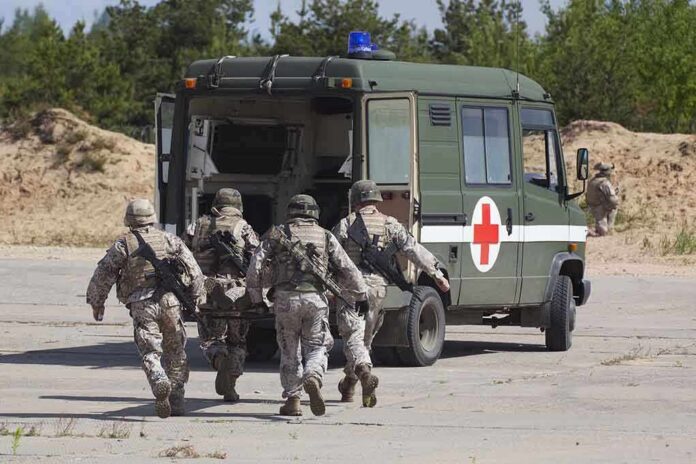
When a government exports its security doctrine, it is making a claim about what works; El Salvador’s decision to mount a military operation in Haiti to rescue four kidnapped aviation technicians is the clearest sign yet that the “Bukele model” of hard-edged gang suppression has moved from domestic policy to foreign posture.
The Short Version
- El Salvador launched a military operation in Haiti to rescue four Salvadoran aviation technicians abducted after a gang ambush near Port-au-Prince.
- President Nayib Bukele framed the mission as a focused rescue with a sharper response if the hostages are not returned alive and unharmed.
- The hostages are part of a UN-backed multinational Gang Suppression Force; the incident underscores the force’s rising clash rate with Haitian criminal groups.
- This episode extends El Salvador’s hard-security doctrine beyond its borders, a model increasingly referenced across the region.
What Happened: A Targeted Military Operation With Clear Political Signaling
El Salvador’s president, Nayib Bukele, announced that he had ordered a military operation in Haiti to recover four Salvadoran aviation technicians seized by gangs after an attack on their armored vehicle outside Port-au-Prince. The men are described as aviation technicians—specialists attached to a UN-backed multinational mission in Haiti—not front-line combat troops. Bukele’s statement carried a blunt conditional warning: return them alive and unharmed or face a more forceful response. Multiple outlets reported the announcement and its terms, which centered explicitly on the rescue of Salvadoran personnel.
The kidnappings occurred against a backdrop of escalating gang confrontation with the multinational mission, where hostile incidents reportedly jumped from low single digits to more than a dozen over a month as gangs test the force’s perimeter and resolve. In public remarks from mission-aligned officials, the message was equally pointed: the captured Salvadorans are not forgotten and will be brought home, with explicit expressions of U.S. support for the force’s posture.
Mechanism and Scope: How Such a Mission Works
A hostage-recovery operation in an urban battlespace like Port-au-Prince demands three ingredients: actionable intelligence on captors and location; a capable entry element with mobility, communications, and medical support; and assured extraction corridors or airlift. El Salvador’s military has honed rapid urban cordon-and-search and perimeter-dominance tactics during its domestic anti-gang campaign, often pairing intelligence penetration of networks with overwhelming presence. Exported to Haiti, the skillset would adapt to a joint framework—intelligence sharing, liaison with host-nation and UN mission command, and deconfliction to avoid blue-on-blue incidents. Aviation technicians, by role definition, support medevac and air operations; rescuing them likely leans on the very assets they help sustain.
That said, Haiti’s gang structures differ from the fragmented street cliques of El Salvador in both armament and local sovereignty. Armed groups in Port-au-Prince control neighborhoods, chokepoints, and informal taxation, and they can mass fighters quickly—environmental facts that drive planners toward multi-axis entries, deception moves, and, when necessary, sequential raids designed to compress the decision window for hostage-takers. None of this changes the immediate objective: recover the four men intact and limit unnecessary escalation.
How We Got Here: From Domestic “Territorial Control” to External Applications
El Salvador’s internal security paradigm since 2022 has centered on an extended state of exception, mass detentions, and militarized policing aimed at dismantling gang command-and-control. Proponents point to a steep fall in homicides and reclaimed public spaces; critics warn of due-process erosion and executive overreach. Whatever one’s view, the operational method—speed, scale, information dominance—has become a political export: leaders from Ecuador to Honduras have studied or borrowed pieces of it, an acknowledgment of its raw efficacy as a crisis stabilizer even as the rule-of-law bill comes due in parallel debates.
This internationalization was, in hindsight, predictable. A government that defines legitimacy through security gains will seek to protect its uniformed personnel abroad, signal resolve to adversaries, and reassure domestic audiences that the state’s custodianship travels with its citizens. The Haiti operation sits precisely at that intersection: a discrete rescue mission that also communicates that Salvadoran troops and technicians, even when deployed multilaterally, remain under a decisive national umbrella.
Haiti’s Operating Environment: A Harder Target Than El Salvador
Haiti presents complications that differ in kind, not just degree. Armed groups function as quasi-sovereign actors in portions of the capital, maintaining checkpoints, levying exactions, and fielding heavy weaponry uncommon in El Salvador’s post-2022 street fights. The multinational mission—tasked now with suppression rather than mere deterrence—faces a moving opponent adept at dispersal, intimidation, and information warfare, all while the political center remains brittle. Reports linked to the mission described an ambush that dumped “hundreds of bullets and explosives” into a Salvadoran armored vehicle; four soldiers survived but were unaccounted for, a detail that underscores both the intensity of contact and the fog that follows such attacks.
Operationally, this means any rescue effort must assume rapid hostage relocation, layered neighborhood defenses, and the possibility that rival gangs may exploit the crisis for leverage. It also raises the stakes for precision: a successful operation extracts the hostages while preserving the mission’s broader legitimacy; a ham-fisted one risks collateral damage that could poison the mission’s consent and hand propaganda wins to criminal factions.
The Bukele Model Abroad: Promise, Limits, and Regional Meaning
El Salvador’s wager is that high-confidence, high-tempo tactics can outperform the slow bleed of incremental containment. The model’s promise abroad is credibility: few governments can claim to have methodically collapsed gang extortion economies as El Salvador has; that record carries deterrent value when shouted across borders. But there are limits. At home, the state could reshape legal authorities overnight; abroad, it must fit within UN rules of engagement, multinational command chains, and host-nation sovereignty—frictions that naturally slow decision cycles and hem in the more maximalist impulses. The broader region has nonetheless taken notice; analysts increasingly describe variations of this hard-security template as a new political common sense in parts of the Americas.
For Haiti, the immediate metric is narrow: do the four return alive, and can the mission sustain freedom of movement after the rescue without provoking broader conflagration? For El Salvador, the metric is dual: successful extraction validates the exportability of its doctrine; failure or excessive force would furnish its critics with ammunition that domestic gains depend on legal shortcuts and permissive environments that don’t exist elsewhere.
Bukele Cleaned Up El Salvador and Is Now Tackling Haitian Gangs | Antonio Graceffo, The Gateway Pundit
El Salvador’s President Nayib Bukele announced on Oct. 21 that he had launched a military operation to rescue four Salvadoran aviation technicians kidnapped by gangs in Haiti.… pic.twitter.com/cXrUSObt3N
— Owen Gregorian (@OwenGregorian) October 23, 2026
What to Watch Next: Outcomes and Second-Order Effects
Three outcomes matter. First, the rescue itself—timelines in hostage cases are unforgiving, and the probability of success falls as captors disperse or entrench. Second, the mission’s posture after the operation—whether gangs escalate reprisals against multinational elements or recalibrate under a credible threat of concentrated force. Third, the regional politics of imitation—states facing surges in organized crime will read this case as either a template or a cautionary tale. On that point, the Bukele model has already migrated into neighboring policy debates; Haiti is simply its first explicit trial outside El Salvador’s borders.
Sources:
thegatewaypundit.com, npr.org, washingtonpost.com, euronews.com, apnews.com, journals.umcs.pl