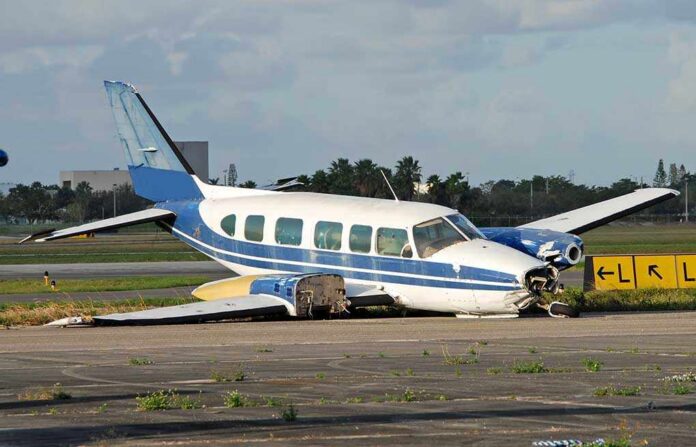
Security video shows a crop-spraying plane tear through a daycare wall in Brazil, yet every child and staff member walked away unharmed.
Story Snapshot
- Firefighters say the pilot was the only injured person; no children or staff were hurt.
- Municipal officials and video confirm the aircraft struck daycare property and damaged a wall.
- The crash site sat about 400 meters from the runway, near a health unit and behind the daycare.
- Investigators from Brazil’s air-accident authority opened a probe into the cause.
What Happened In Campo Verde
On October 23, 2026, a crop-spraying plane hit the grounds of a municipal daycare in Campo Verde, Mato Grosso. Firefighters reported the aircraft fell behind the center, roughly 400 meters from the takeoff runway. They said the pilot was the only victim and that no children or employees were hurt. Local reporting said cameras inside the daycare captured the aircraft smashing a wall, tossing dust and debris across a room. Crews took the 28-year-old pilot for medical care after rescue at the scene.
Municipal education officials said no students were injured, which matched what the video and the fire service showed. Another report said the aircraft first clipped the roof of a nearby health unit and then fell into the rear area of the daycare, which helps explain why the wall damage did not lead to child injuries. Separate coverage added that the pilot, identified as Gustavo Inácio Garcia, was conscious before transport to a local hospital.
Damage, Numbers, And Known Limits
Reports varied on enrollment, citing approximately 180, 183, 176, or “more than 150” children served by the daycare. That spread affects precision, but it does not change the key point: no child or staff member was injured, according to firefighters and city officials. The crash damaged a wall and disrupted classes, with local media noting temporary suspension while repairs moved ahead. Officials have not released details on exact attendance at the moment of impact, and no full injury report for the pilot has been made public.
The pilot’s condition was described in different ways across outlets, from cuts to possible chest injuries. Those details remain secondary to the documented rescue and hospital transport after the crash. The fire service placed the impact about 400 meters from the runway, behind the daycare, giving a concrete picture of how close the aircraft came to occupied rooms that morning. Video evidence of the wall strike backs up the accounts of localized damage inside the daycare.
Who Is Investigating And Why It Matters
Brazil’s air-accident investigators opened a case to determine the cause. Officials named the national center responsible for investigating and preventing air crashes as the lead on the probe. Early accounts mentioned possible mechanical problems, but there is no official causal finding yet. That is normal in aviation. Investigators will review the aircraft’s path, maintenance, and parts. They will also assess human factors and the layout around the runway.
Understanding the risks of crop-spraying flights helps here. These planes fly low, near wires, trees, and buildings. That work brings higher danger than many other civil flights. Brazil’s civil-aviation safety report shows agricultural aircraft made up about 5 percent of the fleet but more than 34 percent of civil-aviation accidents in 2020. Safety materials from Brazil’s aviation regulator also flag agricultural operations as a persistent risk area.
Why This Close Call Hits A Nerve
Parents see a system that often reacts after the fact. People on the left and right worry that leaders cut corners, then ask families to live with the risk. A plane going down at a daycare proves how thin the margin can be near busy farm strips and growing towns. This case shows how strong emergency work and plain luck can spare lives. It also shows why prevention, not spin, should drive policy and funding.
🇧🇷 A small agricultural plane crashed into a daycare with around 180 children inside in Campo Verde, Brazil, on October 23.
But thank God nobody was hurt except the plane passengers pic.twitter.com/zkqaEngRdl— DJ CandyMan (@DrCandymn) October 27, 2026
Local leaders can act on basic steps while the probe runs. They can map low-altitude flight paths over schools and clinics. They can tighten zoning near runways used for crop-spraying. They can add simple barriers that slow debris. They can run drills with schools so teachers know where to move kids fast. These are not partisan ideas. They are common-sense guardrails that protect families while investigators finish the hard technical work.
Sources:
ofactual.com.br, agoramt.com.br, oportal163.com.br, g1.globo.com, estadaomatogrosso.com.br