
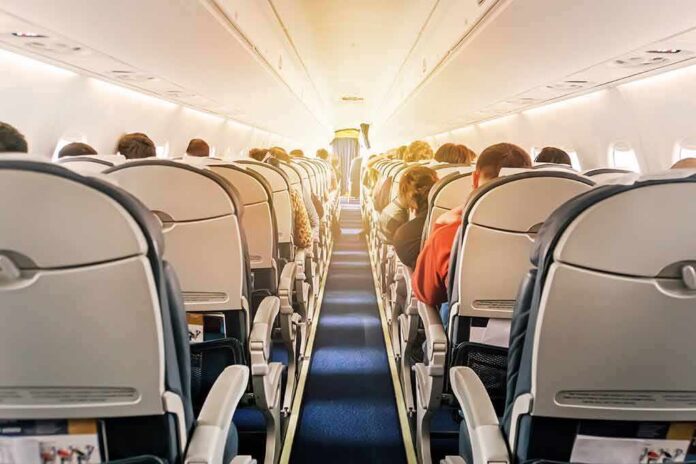
A flight dispute over one seat turned into an arrest, an assault probe, and a wider fight over who sets the rules in the cabin.
Quick Take
- Police said the passenger refused to stay in his assigned seat because a woman sat nearby.
- Reports said he cited Sharia law as his reason for the refusal.
- Authorities said he later admitted to slapping or punching a female flight attendant.
- The case adds to a pattern of in-flight seating disputes that quickly become safety issues.
What Police Said Happened
German police said the June 1 flight landed in Düsseldorf with an on-board disturbance already underway. According to reporting based on police statements, the passenger would not remain in his assigned seat because it was next to a woman. Police also said he was taken into custody after landing and later admitted to assaulting the flight attendant during questioning.
That sequence matters because it turns a seating dispute into a public safety case. The reported facts are simple and hard to ignore: a passenger objected to sitting beside a woman, crew stepped in, and the situation ended with physical violence. Police then added a second charge after he allegedly insulted officers in Turkish during the aftermath.
Why the Sharia Claim Drew Attention
The claim drew more attention than an ordinary cabin argument because the passenger reportedly tied his refusal to Sharia law. That detail pushed the story beyond a fight over comfort or etiquette. It raised the question of whether a personal religious objection can override airline seating rules. The reporting does not provide a specific Islamic ruling that requires such a refusal.
German law does not give Sharia law standing as a legal code, so the reported justification would not excuse assault or refusal to follow crew instructions. The stronger part of the record is not the religious claim itself, but the later alleged admission and the witness reports that he would not sit next to a woman. Those points are what made police treat it as a criminal matter.
Why This Story Resonates Beyond One Flight
This incident fits a broader pattern that frustrates people on both sides of the political divide. Many readers see it as another example of institutions having to manage clashes between personal beliefs and basic public rules. Others see the same event as proof that air travel is becoming one more place where social tension spills into conflict. Either way, the cabin is not a place where private doctrine can replace crew authority.
German police arrested a passenger after he allegedly refused to sit next to a woman on a flight, reportedly claiming that doing so would violate his interpretation of Sharia law. ‼️Authorities say that when a female flight attendant tried to resolve the situation, the man… pic.twitter.com/To9WsHICfZ
— Jade Warwick (@TheJadeWarwick) July 20, 2026
Airlines have long faced seat disputes, but most are about space, comfort, or family travel. Religious objections to sitting next to women are rarer and far more volatile. In this case, the reported result was not a compromise but an arrest. That is why the story keeps spreading: it combines religion, gender, disorder, and the sense that a small dispute exposed a bigger breakdown in respect for rules.
Sources:
thegatewaypundit.com, abcnews4.com, newsbreak.com, europeanconservative.com, instagram.com, en.wikipedia.org