
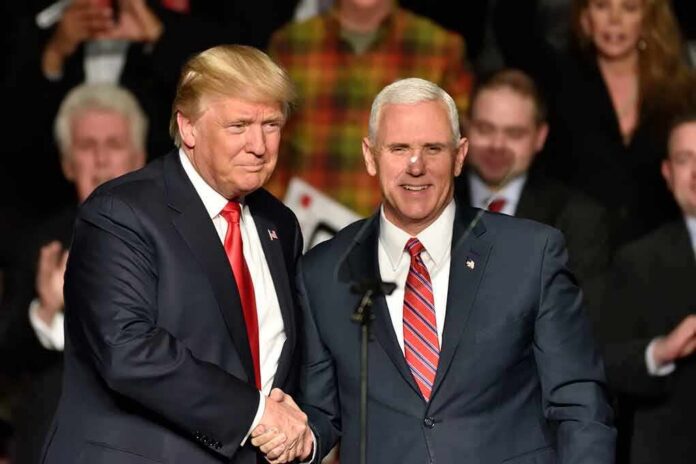
Trump’s Labor Day message was not an aberration; it was a textbook deployment of his now-familiar political style—naming enemies, elevating stakes to existential terms, and welding partisan identity to national survival.
The Short Version
- President Trump’s Labor Day post explicitly labeled Democrats and “the left” as radicals and communists intent on destroying the country, and cast the next elections as a last-ditch fight for America.
- This fits a durable rhetorical pattern in which Trump uses antagonistic and norm-violating language more frequently than recent major-party presidents and nominees.
- Scholarly analyses quantify the distinctiveness and divisiveness of Trump’s discourse and track a rise in violent or hostile vocabulary over time.
- Supporters see mobilizing clarity; critics see escalatory language that hardens polarization and narrows space for democratic cooperation.
What Trump Said, and Why It Matters
In a Labor Day message, Trump extended holiday well-wishes to “all, including the Radical Left Lunatics, Communists, and Dumocrats who will do anything possible to destroy our Country,” and argued that his opponents had spent a decade fighting him and were taking “one last shot at ruining America.” The post doubled as a campaign frame for the coming contests: a moral and existential struggle with victory promised on his side. The thrust was unambiguous—separate the political field into patriots and saboteurs—and it was delivered in the clipped, derisive cadence that has become his signature. The rhetoric, and the attack taxonomy—radical, communist, corrupt—are consistent with his prior event speeches and online messaging.
To focus narrowly on the insult vocabulary misses the function: this is mobilization language. By inflating the stakes, casting the opposition as civilizational antagonists, and projecting inevitability of victory, Trump attempts to harden in-group loyalty and raise the psychological cost of defection. The timing—Labor Day, the unofficial gateway to fall campaigns—was purposeful. It transforms a civic holiday about work and solidarity into a staging ground for partisan alignment, where even the greeting card carries a battle cry.
How This Fits Trump’s Larger Rhetorical Repertoire
Trump’s message belongs to a larger pattern that researchers have documented across his speeches and social posts since 2015: a distinctive, divisive, and increasingly hostile style that departs from the register of recent major-party presidents and nominees. Large-scale textual analyses comparing presidential discourse since 1960 find Trump’s language is uniquely distinctive and more polarizing in references to political opponents. Complementary academic work identifies “insult politics” as a structural feature rather than an occasional flourish—deprecation, denigration, and domination recur as organizing modes, not rhetorical detours.
Several quantitative studies have tracked a rise in violent or conflict-coded vocabulary within Trump’s public remarks. An NBER analysis found an upward trend in violent word usage since 2015, surpassing that of other democratic politicians studied; the increase reflected greater attention not only to wars but to crime, and it persisted across venues and cycles. A separate research team reported that the share of violent language in Trump’s speeches roughly tripled from 2016 to mid-2020s, placing his recent rhetoric above peers and predecessors. While methodologies vary, the convergence of findings—distinctiveness, divisiveness, upward drift in combative lexicon—renders the Labor Day post unsurprising to anyone who has followed the arc of his communication.
Mechanism: Why This Language Works for Its Intended Audience
Three mechanisms explain the durability of this style. First, boundary maintenance: attaching charged labels to opponents (“radical,” “communist”) converts policy disputes into identity threats, discouraging cross-pressured voters from splitting tickets and making apostasy reputationally costly within the group. Second, affective activation: norm-violating speech—insults, transgression, taboo play—triggers attention and emotion, two preconditions for recall and turnout. Work in political communication shows that norm-breaking can polarize democratic attitudes among an incumbent’s supporters, reducing support for inclusive norms even when abstract attachment to “democracy” remains steady. Third, narrative compression: crises, enemies, and imminent victory form a closed motivational loop that simplifies a complex world into a morally legible campaign pitch.
Critics often ask whether this language “goes too far,” but that question presumes the goal is persuasion across the aisle. Trump’s communication consistently prioritizes activation—of loyalists, infrequent voters, and those for whom politics is a team sport—over broad persuasion. On those terms, the Labor Day message aligns with the strategy.
Historical and Comparative Context
American presidents have insulted rivals before; partisan invective is hardly new. What is unusual is the frequency and centrality of insult and threat framing to a sitting president’s routine messaging calendar. Comparative discourse studies—spanning stump speeches, rallies, and social media—find Trump’s language deviates not merely in flavor but in structure: higher rates of denigration, simplified syntactic patterns for punch, and a persistent dichotomy between virtuous in-group and corrupt out-group. Scholars have described the style as a populist dramaturgy—casting elites and opponents as oppressors, dramatizing crisis, and relying on “bad manners” to signal authenticity to supporters who view traditional politeness as elite camouflage.
That dramaturgy maps neatly onto the Labor Day post. A holiday about the dignity of work becomes a stage for crisis narrative; the opposition is not wrong but malign; victory is promised not only as a political outcome but as moral restoration. If you accept the frame, the policy specifics recede; what matters is team strength and willingness to fight.
Where Reasonable Disagreement Lives
The live debate is not whether Trump uses unusually antagonistic rhetoric—the corpus evidence is robust on that score—but what it does to American politics. One camp argues it is a rational adaptation to a coarse media ecosystem: in a crowded attention market, transgression cuts through, and his supporters interpret the barbs as ordinary partisan combat. Another camp contends that the normalization of threat-coded and delegitimizing language corrodes the procedural trust that pluralistic democracy requires, narrowing space for compromise and increasing acceptance of extraordinary countermeasures. Experimental and observational work suggests norm-violating rhetoric can polarize views on democratic inclusiveness among supporters, even when high-level democratic preferences remain unchanged. The stakes, in other words, are institutional as much as electoral.
Implications for Campaigns and Governance
Expect more, not less, of this register as competitive cycles intensify. Rhetorical choices are habit and strategy; in Trump’s case, they are brand. For Republican candidates, the message simplifies the loyalty test while complicating coalition growth: energizing the base even as cross-pressured moderates and suburban voters may recoil from constant brinkmanship. For Democrats, the temptation will be to mirror escalation; the smarter move is often counter-programming with policy specificity and competence narratives, allowing contrast on tone and substance to accumulate without surrendering energy.
For governing, language shapes the feasible set. When the opposition is cast as a mortal threat, routine bargaining looks like capitulation. That narrows the lanes for bipartisan legislation and steers presidents toward unilateral tools—executive actions and rhetorical campaigns—at the cost of durable settlements. The Labor Day message was a holiday post; it was also a signal about the terms on which the next season of American politics will be fought.
Trump in Labor Day Message Says GOP Will Win Big in Midtermshttps://t.co/mSBhIMq9Oq
— YoungDuck (@lduck623) September 7, 2026
How to Read the Next Round
Filter the slogans for structure. Watch for the triad that defined this post—enemy labels, existential stakes, promised victory—and you will see the strategy behind the spectacle. It is not improvised belligerence; it is the operating system. Analysts should evaluate it on outcomes that can be measured: base activation, cross-pressured defections, and downstream effects on institutional cooperation. The rhetoric is likely to keep working for the audience it is designed to move; the open question is what it asks the American system to absorb in return.
Sources:
democrats.senate.gov, whitehouse.gov, newsweek.com, govinfo.gov, news.meaww.com