When a healthy baby arrives on the shoulder of a busy urban artery, it reads like a miracle; in truth, it is also a case study in how peak-hour congestion reshapes emergency medicine from the curb up.
At a Glance
- A San Francisco mother delivered a healthy baby girl roadside after Golden Gate Park traffic stalled the family’s drive to the hospital; first responders completed the delivery and transported mother and child.
- The incident unfolded near Crossover Drive and Martin Luther King Jr. Drive during late-afternoon congestion, with crews dispatched after 4:30–4:40 p.m., according to reports referencing the San Francisco Fire Department.
- Accounts indicate an ambulance was impeded by gridlock, forcing medics to proceed on foot for the final stretch to reach the vehicle safely.
- Urban EMS research consistently shows that rush-hour traffic extends ambulance travel times far more than call-processing times, making outcomes like roadside births predictable rather than freakish.
What Happened: A Roadside Birth in Gridlock
A San Francisco family heading to the hospital found themselves immobilized in late-afternoon traffic within Golden Gate Park; when contractions turned to an urge to push, they pulled over on Crossover Drive near Martin Luther King Jr. Drive and dialed 911. Reporting based on San Francisco Fire Department timelines places the start of the roadside delivery shortly after 4:30–4:40 p.m., squarely within the evening peak. Responders arrived, assisted the delivery, and mother and baby were later transported in stable condition. The core facts—location, timing in rush-hour conditions, and a successful outcome aided by fire and EMS—are uncontested across local coverage that cites SFFD as the official timeline source.
One account adds a detail that emergency veterans will recognize: gridlock also constrained the ambulance’s final approach, so medics closed the last distance on foot to reach the family’s vehicle and complete the delivery. That choice—leaving the rig, grabbing the kit, running the last blocks—is textbook field judgment when seconds matter and the unit can’t thread through traffic safely.
Mechanism: Why Peak Traffic Converts Obstetrics into Field Medicine
Emergency medical responses have two distinct time domains: call handling (from 911 pick-up to unit dispatch) and travel (from dispatch to arrival on scene). In dense cities, the first domain is relatively controllable with trained call-takers and triage protocols; the second is at the mercy of road geometry and volume. Studies of urban EMS access show compliance with sub–5-minute call handling benchmarks can be strong while travel times swell sharply during the evening peak, when vehicle density and signal delay compound across short urban blocks.
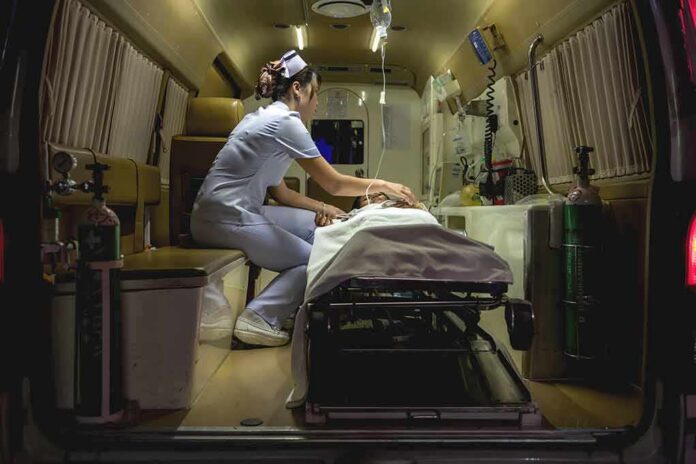
Obstetrics adds an unforgiving physiological clock. The second stage of labor—pushing—can compress into minutes for multiparous patients or precipitous labors, and once crowning begins, moving the patient is often medically unwise. That is why field obstetrics kits and neonatal warmers live on every ambulance, and why crews train to deliver, suction, stimulate, and manage postpartum hemorrhage roadside if necessary. Congestion doesn’t cause labor; it removes the hospital as a guaranteed setting and shifts definitive care onto the street shoulder.
Context: This Was Not a Fluke—It Fits a Broader Urban EMS Pattern
Across cities, congestion creates travel-time vulnerability for ambulances, especially in peak windows and constrained corridors. Comparative EMS research from multiple urban contexts has documented the pattern: call processing can remain efficient while dispatch-to-scene times degrade most in the evening rush; in practical terms, that is exactly when laypeople are also driving loved ones to hospitals and when roadside emergent care becomes likeliest.
The policy literature points to actionable levers. Natural experiments in traffic management—most prominently congestion pricing—show measurable improvements in emergency response, trimming total EMS travel by roughly 63–70 seconds, or about 5–6 percent. That margin sounds small until you’re measuring airway compromise, hemorrhage, or a newborn’s first spontaneous breath; in that clinical theater, a minute is meaningful.
The Dispatch Timeline: What We Can Say Confidently
For this San Francisco case, the consistent elements across reports are straightforward: late-afternoon start of delivery, Golden Gate Park’s Crossover Drive at MLK Jr. Drive, stalled traffic during the evening peak, 911 activation, fire and EMS on scene, and transport after a successful roadside birth. Stories that anchor their timeline to SFFD place the initial 911 activation and dispatch just after 4:30–4:40 p.m., which aligns with the period when urban EMS data finds maximum travel delay relative to off-peak baselines.
One outlet further describes medics navigating the final blocks on foot due to gridlock—entirely plausible given the corridor’s limited passing options and the safety calculus around siren use in bumper-to-bumper conditions. That sequence fits the standard operating procedure many agencies use in gridlock: stop the rig as close as feasible, advance with gear, make contact, deliver or stabilize, then coordinate vehicle repositioning or patient transfer when traffic flow allows.
What This Means for Patients, Providers, and Planners
For expectant families: precipitous labor is rare but not mythical. Knowing the closest emergency department and alternative routes, keeping a charged phone, and understanding that stopping safely and calling 911 is sometimes the right decision can convert chaos into an orderly field delivery overseen by trained professionals. In major metros, that decision is more likely to be forced during the evening commute window; families who are high risk or far from a hospital should plan their travel with that clock in mind.
For EMS and fire agencies: evening peak staffing, dynamic deployment (posting units where demand and road friction will be highest), motorcycle or bicycle medic programs for ultra-dense corridors, and protocols that empower crews to abandon rigs and proceed on foot all reduce on-scene intervals when traffic locks up. These are not theoretical fixes; they are playbook items validated in cities that face even heavier congestion, and they buy back minutes when minutes set outcomes.
Policy Levers: Buying Back Minutes Systemically
Transportation policy can be emergency medicine policy by another name. Congestion pricing schemes, transit signal priority, and rapid incident clearance reduce the ambient friction that slows ambulances and citizen drivers alike. Empirical analyses of congestion pricing’s first-order traffic effects have already quantified the EMS benefit window—on the order of a minute shaved from response times—which scales across tens of thousands of high-acuity calls per year in a large metro.
Cities also control curb space and lane priorities around hospitals and along key arterials. Protecting emergency lanes, calibrating signal preemption for ambulances, and designing chokepoint work zones with emergency ingress in mind are not glamorous interventions. They are, however, the ones that keep newborns from meeting the world beside a guardrail.
A healthy baby girl made an unexpected roadside arrival Friday afternoon after her family got stuck in heavy traffic on the way to the hospital, according to the San Francisco Fire Department. https://t.co/u9EgUOveQB pic.twitter.com/1GWuFkX8V5
— NBC Bay Area (@nbcbayarea) September 20, 2026
Bottom Line
The San Francisco roadside delivery ended well because the family stopped when they needed to, called 911, and received competent field care from responders who navigated the last yards despite gridlock. It also underscores a broader truth: in dense cities, the evening peak quietly rewrites the script for emergencies. If you can’t reliably move the patient to the hospital in time, you must bring the hospital to the patient—through training, tactics, and, upstream, transportation policies that buy back the minutes modern emergency medicine needs to work.
Sources:
nypost.com, yahoo.com, sfist.com, abc7news.com, latimes.com, ktvu.com