
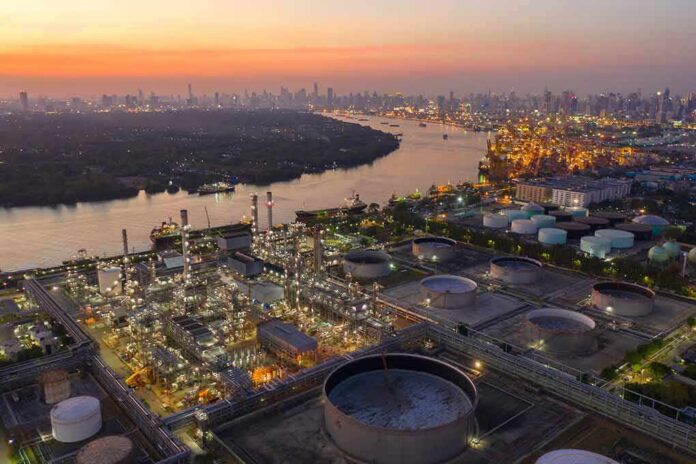
Analysts say roughly 90% of Iran’s crude exports move through tiny Kharg Island, creating a single chokepoint the United States can disrupt at will.
Story Highlights
- Reuters and CNN report Kharg handles about 90% of Iran’s oil exports
- Energy trackers show the hub’s concentration remained above 90% in recent years
- Analysts warn sustained disruption at Kharg would cut Iran’s export revenue fast
- Reports show both continued shipments and periods of sharp slowdowns under pressure
Kharg Island’s outsized role in Iran’s oil economy
Reuters and other outlets identify Kharg Island as the main loading point for Iran’s crude, handling about 90% of exports. The island sits off Iran’s coast with long jetties built for supertankers. That layout makes it efficient and also exposed. When one small spot moves most barrels, a strike, blockade, or insurance squeeze can ripple fast through markets and state revenue. This is why markets and governments treat Kharg as a strategic chokepoint and a clear vulnerability.
Independent energy intelligence backs up the scale of that concentration. Argus cites shipping data showing about 92% of Iranian oil exports originated at Kharg during 2023 to 2025. That figure tracks with other coverage that pegs the share near 90%. The exact number shifts by month, but the story stays the same. Most of Iran’s crude flows through Kharg. That makes any sustained disruption there a direct hit on Iran’s budget and its ability to fund regional activity.
Disruption tools: military strikes, sanctions, and shipping risk
Coverage since March 2026 shows how pressure on Kharg can change tanker behavior in a hurry. Some reports describe continued loadings after U.S. strikes, with exports estimated around 1.1 to 1.5 million barrels per day. Other reports describe periods when tankers avoided the island and no vessels loaded for days under a renewed U.S. naval presence. These mixed signals reflect a simple fact: even short slowdowns at a single hub can move prices and policy fast.
Analysts warn that sustained, targeted disruption at Kharg would sharply curb Iran’s exports. Anadolu quoted a Gulf energy expert saying Iran’s export system relies on this one spot and that lasting disruption would quickly hit government revenue. Market notes cited by regional outlets echo that point, calling Kharg a critical vulnerability. If the hub stalls, most of the country’s crude cannot reach ships in time to keep cash flowing at normal levels.
What “control” really means — leverage versus shutdown
The claim that the United States can “control” 90% of Iran’s exports stretches beyond the public record. The strongest evidence supports “disrupt,” not “control.” Reports note that Iran continued to ship oil from Kharg after strikes, and satellite tracking sometimes showed no major drop in loadings. At the same time, other coverage records weeks with sharp slowdowns. The pattern shows leverage is real, but a total, lasting shutdown is not proven by open sources.
BREAKING | U.S. Message to Tehran: A New Chapter Has Begun — Energy Infrastructure Is Now on the Table
Following the strike, the United States delivered a message to Tehran through Qatar: If Iran continues to escalate, Washington is prepared to move from targeting military…
— דרור בלאזאדה | Dror Balazada (@DBalazada) September 2, 2026
For U.S. interests, the takeaway is clear. Kharg is Iran’s economic Achilles’ heel. Pressure there offers fast leverage without a ground war. But any action must weigh blowback on global prices and allies. President Trump’s team has signaled resolve and restraint, targeting military assets while keeping oil markets stable. The evidence shows Washington has tools to squeeze the hub when needed, while keeping options open to avoid a full-scale energy shock.
Sources:
youtube.com, cfr.org, en.wikipedia.org, theguardian.com, jpost.com, cnn.com, pbs.org