
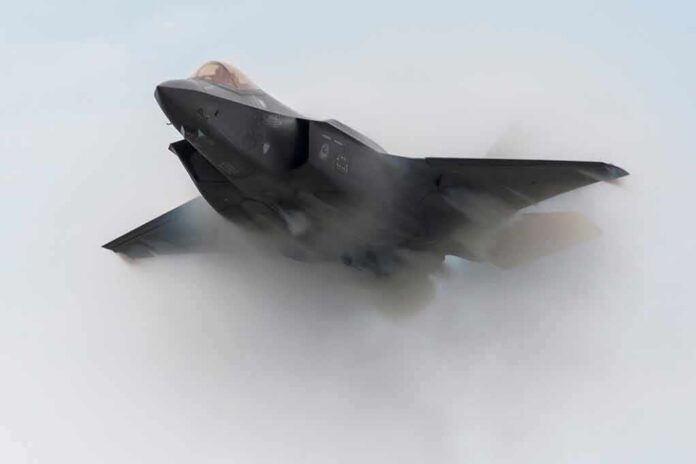
Stealth kills at long range, but numbers and geometry can still force the fight into a knife fight; that is the enduring lesson from exercises where F-16 aggressors used multi-axis “swarm” tactics to pressure F-35s into visual-range engagements.
At a Glance
- Exercise data show F-35s dominating overall at range, yet absorbing most losses after the merge when outnumbered and compressed into close combat.
- “Swarm” tactics—multi-axis, saturation attacks—can accelerate missile expenditure and erode stealth advantages once internal weapons are gone.
- Scenario design governs outcomes: sensor support, rules of engagement, and loadout often matter more than airframe lineage.
- The future answer is integration: pairing stealth fighters with collaborative combat aircraft (drones) and networked shooters to keep the fight at standoff.
What the exercises actually showed
The most-cited datapoint in this debate remains Red Flag 17-1. Thirteen F-35As posted an Air Force-credited 145-to-7 air-to-air tally, an emphatic demonstration of the platform’s beyond-visual-range (BVR) edge. Yet the same reporting highlights the pressure point that captivates critics and tacticians alike: every F-35 loss occurred within visual range after merges that followed multi-axis pressure from aggressor F-16s. That juxtaposition—dominance at range, vulnerability when compressed—is the core truth. It neither dethrones the F-35 nor crowns the F-16; it exposes how rapidly the geometry of a fight can invert advantages.
Accounts summarizing aggressor tradecraft describe “swarm” behavior loosely—coordinated multi-direction approaches designed to saturate the defender’s sensor picture and weapon allocation, draw early shots, and then collapse distance from multiple bearings at once. The logic is straightforward. A stealth jet carrying four internal AMRAAMs cannot service unlimited tracks; a red air four-ship, reinforced by additional elements or datalink cues, can present more simultaneous problems than a single blue element can kill before the merge. Once missiles are expended or the intercept window closes, the fight becomes a short-range contest where agility, nose authority, and pilot energy management reassert themselves.
Mechanism: why numbers and angles compress a stealth fight
Stealth is a range and angle game. Reduce radar cross-section and you deny or delay opponent detection; pair that with passive sensors and high-fidelity fusion and you usually “see first, shoot first.” But the timeline advantage is finite. Multi-axis presentations shorten the defender’s decision cycle and fragment shot opportunities. A fighter that can queue two, maybe three high-probability shots before timelines converge is still out of phase if five shooters appear across its front and quarter lines with overlapping weapons employment zones. The result is tactical compression: the merge happens on someone’s terms; if it’s not yours, your advantages narrow rapidly.
Internal carriage amplifies this dynamic. The F-35’s design trades magazine depth for signature; keep weapons internal and the jet remains hard to target, but magazine depth is limited. External pylons add capacity but at the cost of signature. Exercises that constrain loadout to pure internal carriage—not unusual for stealth vignettes—are implicitly testing whether tactics and integration can preserve the BVR kill chain long enough to win before numbers collapse that chain. When aggressors coordinate well, they can sometimes break it anyway.
History and context: dogfight myths and BVR realities
Public arguments about F-16s “beating” F-35s often anchor on a 2015 test report describing an early F-35 configuration struggling in a guns-only close-in trial against an F-16. Program officials countered at the time that the jet is optimized to avoid such fights by killing before the merge, which is both true and incomplete; stealth platforms still train for merges because wars are messy and geometry does not honor design briefs. That is why Red Flag data matter: they reveal both sides of the ledger—how the F-35 harvests BVR advantages, and how losses tend to cluster when it’s dragged into visual-range amid numerical pressure.
The larger pattern is familiar to anyone who has pored over dissimilar air combat training: outcomes are scenario-dependent. Rules of engagement, blue-red numbers, AEW&C and tanker support, emission control, electronic attack, and even cloud decks shape what “wins.” A four-ship of F-35s with robust offboard cueing can dismantle a like-sized fourth-generation formation at standoff. Change the ratios, constrain weapons, or withhold support, and you incentivize the underdog to force a merge where agility and pilot cunning can buy kills—and headlines. None of that contradicts the F-35’s role; it explains the boundaries of its advantage.
What “swarm” means in manned-on-manned air combat
In the aggressor community, “swarming” against manned fighters does not imply dozens of robots; it means coordinated multi-axis, time-on-target pressure from multiple manned elements. Think of it as saturation geometry: bracket from the front quarter while a high-element drags from above and a trailing pair threatens a delayed merge. Each axis demands sensor time, each track demands a missile—or at least a crank and a notch—stealing precious seconds. The defender, mindful of remaining missiles and timelines, accepts a merge on a less-than-ideal vector. In that moment, the F-16’s famed energy maneuverability can matter, particularly if the F-35 has bled energy prosecuting earlier shots. The Red Flag record—BVR dominance with losses clustered inside the bubble—maps directly to that playbook.
There is a second “swarm” meaning that does involve robotics: uncrewed, networked collaborative aircraft. Those swarms challenge stealth differently—by multiplying sensors and aimpoints beyond what a single fighter can service with missiles or jamming. That is a distinct problem set from F-16 aggressors, but the through-line is similar: multiplicity stresses finite magazines and pilot bandwidth.
Counter-swarm logic: integration, magazine depth, and human-machine teaming
The enduring solution set is not to turn stealth jets into dogfighters; it is to keep the fight at range longer and raise the cost of closing. Three levers matter. First, integration with offboard sensors and shooters—AEW&C, surface-based air defenses, and partner fighters—expands the kill web so a stealth four-ship is not fighting alone. Second, greater magazine depth—be it via external pylons in accepted threat windows, carriage of smaller effectors, or airborne weapons trucks—addresses the arithmetic problem that swarming creates. Third, collaborative combat aircraft (CCA) wingmen extend the F-35’s “hands,” offering additional sensors, decoys, and missiles to dilute an attacker’s saturation play. Lockheed Martin and the services are already prototyping cockpit control and autonomy for this teaming model, precisely to manage multi-axis threats without ceding the merge [WSJ video referenced in social research].
Even before CCAs arrive in squadron strength, tactics continue to evolve. Blue air can break aggressor swarms by disrupting timing—killing the leading element early, jamming datalinks to desynchronize brackets, or using deceptive emissions to miscue an axis. The point is doctrinal: treat saturation as a system-of-systems problem, not a furball inevitability, and you preserve the F-35’s long-range advantage where it is most lethal.
Where legitimate debate remains
Two real questions divide practitioners. The first is magazine and cost exchange: how many missiles can a stealth jet afford to spend per kill before the economics turn against it, especially when adversaries can field larger formations or cheap uncrewed adjuncts? Exercises that show accelerated expenditure under swarming pressure are warning shots; they argue for payload evolution and cheaper effectors to maintain favorable exchange ratios. The second is training emphasis: given that merges still happen, how much syllabus time and engineering investment should go to high-angle-of-attack handling, helmet-cued off-boresight shots, and gun employment? The answer inside fighter squadrons has been pragmatic: train for both ends of the envelope and avoid purity wars over BVR versus WVR. The exercise record supports that pragmatism.
Implications for planners and buyers
The right takeaway is not “F-16s beat F-35s” or its mirror-image. It is that air dominance in the 2020s and 2030s hinges on sustaining standoff advantage against opponents who are actively trying to compress it. That emphasis leads naturally to investments in CCA wingmen, distributed sensors, electronic attack, and more missiles per sortie. It also validates the boring but essential work of tactics development: timing control, deception, and disciplined fire control in the face of saturation plays.
Sources:
19fortyfive.com, breakingdefense.com