
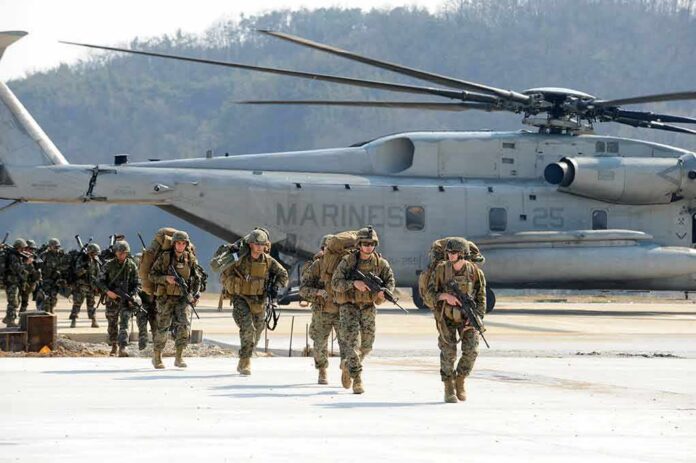
The central fact is simple: the United States carried out a new round of strikes inside Iran, and publicly cast them as a force-protection operation tied to Iranian attacks on American personnel and maritime targets. The larger significance is equally clear: this was not presented as a symbolic raid, but as a deliberate attempt to degrade Iran’s capacity to threaten U.S. forces, shipping lanes, and the military systems that support both.
Intro Header
- The U.S. strikes were described by CENTCOM as a response to Iranian attacks and as an effort to reduce future threats.
- Reported targets included command centers, air defenses, missile and drone facilities, radar, surveillance, boats, and maritime capabilities.
- Reuters said the military struck more than 80 targets in one round, underscoring the scale of the operation.
- The public record is strong on what the U.S. said it hit, and weaker on the forensic chain behind the triggering Jordan incident.
What the strikes were meant to do
CENTCOM’s public line matters because it tells you how the Pentagon wanted the operation understood. The strikes were framed as self-defense: a response to Iranian attacks, aimed at degrading the capacity of Iran’s military network to threaten U.S. forces and the flow of commercial shipping through the Strait of Hormuz. That language is not incidental. It is the standard legal and strategic vocabulary of modern airpower when commanders want to show that a raid is not open-ended punishment, but a limited action tied to force protection and deterrence.
The target sets reported across the coverage fit that logic. CENTCOM described strikes on military command centers, drone storage, communication networks, coastal surveillance sites, and maritime capabilities; Reuters reported that the U.S. struck over 80 targets, including air defenses, command-and-control systems, coastal radar, anti-ship missile capabilities, and more than 60 Islamic Revolutionary Guard Corps small boats. In plain terms, the objective was to make it harder for Iran to see, decide, launch, and then exploit the Strait of Hormuz battlespace. This is how militaries blunt an adversary’s operating cycle: blind the sensors, suppress the launchers, break the communications, and reduce the tools used to harass shipping.
That helps explain why the operation was described in maritime as well as kinetic terms. CENTCOM said the strikes were intended “to further diminish the threat Iran poses to civilian mariners and commercial vessels transiting the Strait of Hormuz,” making the operation more than a reprisal for a single incident. The U.S. was not merely saying, in effect, “we were hit, so we hit back.” It was saying that the attack required a wider campaign against the infrastructure that enables repeated harassment of ships and U.S. forces in the region.
The Jordan incident that gave the retaliation narrative its force
The retaliation story rests on the claim that an Iranian missile attack on a U.S. base in Jordan triggered the U.S. response. Multiple reports in the package describe the strikes as revenge for that attack, and the BBC transcript summary and Reuters-linked reporting both present CENTCOM’s account that the U.S. operation followed Iranian fire on American positions in Jordan. Several summaries also note that Jordan’s air defenses intercepted missiles, while the U.S. said the attack had been aimed at American forces.
That said, the public record in this package is much stronger on the U.S. response than on the underlying forensic case for the Jordan strike itself. The evidence here is largely official U.S. characterization, repeated by major outlets, rather than a fully independent technical reconstruction of the missile event. We do not get, in this record, the kind of base incident report, debris analysis, radar track, or Jordanian technical disclosure that would let an outside reader test every part of the causal chain. The consequence is not that the U.S. account is undermined; it is that the public can clearly see the retaliatory frame before it can inspect the underlying evidentiary mechanics in detail.
That asymmetry is common in wartime reporting. States announce that they are acting in self-defense, and media organizations often have no choice but to relay those claims while the underlying intelligence remains classified or unpublished. Here, too, the public learns quickly what was struck and why the U.S. says it acted, while the deeper questions of attribution, authorization, and proportionality remain largely behind the curtain. That is not unusual. It is the normal shape of early conflict reporting.
Why the scale of the strikes matters
The scale of the operation tells you something important about the administration’s intent. Reuters’ reporting that the military struck over 80 targets is not the language of a pinprick reprisal; it is the language of a sustained degradation campaign. Other contemporaneous reports in the package describe repeated rounds of strikes across multiple nights, with targets ranging from coastal surveillance to air defense and missile infrastructure. That pattern matters because it shows the U.S. seeking cumulative effects rather than a single dramatic blow.
In operational terms, repeated strikes against sensor arrays, launch platforms, and maritime assets aim to shrink an adversary’s options. A state deprived of surveillance and command continuity has a harder time coordinating attacks on shipping, protecting its own coastline, or signaling resolve without absorbing additional punishment. That is why command centers and radar sites are so often favored targets in this kind of campaign: they are force multipliers. Remove them, and every subsequent attack becomes more difficult, slower, and riskier.
The repeated emphasis on the Strait of Hormuz is also revealing. CENTCOM’s stated rationale tied the strikes to the safety of civilian mariners and commercial vessels. Reuters similarly described the operation as an attempt to degrade Iran’s ability to continue attacking international commerce in the strait. That maritime focus places the strikes inside a long-standing strategic problem: Iran does not need to sink large numbers of ships to impose costs; it only needs to make transit riskier, insurance more expensive, and shipping schedules less predictable. The U.S. response was designed to make that strategy less viable.
What remains uncertain, and what does not
What is not in serious dispute is that the U.S. struck Iranian targets and said it did so in response to Iranian attacks. What remains less fully documented in the package is the exact evidentiary basis for the Jordan trigger event, including the chain of command behind the missile launch, the technical details of interception, and the legal review that connected the retaliation package to the original attack. Those gaps do not erase the operation; they simply mark the boundary between what governments disclose quickly and what they keep classified.
The more interesting analytical point is that the public narrative already contains two layers. One is the immediate trigger: an attack on American personnel or positions in Jordan. The other is the broader strategic rationale: weakening Iran’s air defenses, surveillance, maritime capabilities, and missile networks so that future attacks on U.S. troops and shipping become harder to execute. That dual framing is the real architecture of the story. The first layer explains urgency. The second explains scale.
Seen that way, the strikes were not an isolated eruption but part of a familiar pattern in U.S.-Iran conflict: a localized attack produces a force-protection response, and that response is then broadened to target the systems that made the original attack possible. The public may argue about whether the operation was sufficient, excessive, or strategically wise. But the evidence in this record supports a more basic conclusion first: the United States intentionally used airpower to punish and constrain Iranian military capacity after saying American forces had been attacked.
Sources:
facebook.com, centcom.mil, aljazeera.com, reuters.com, npr.org, youtube.com, bbc.com, wsls.com