
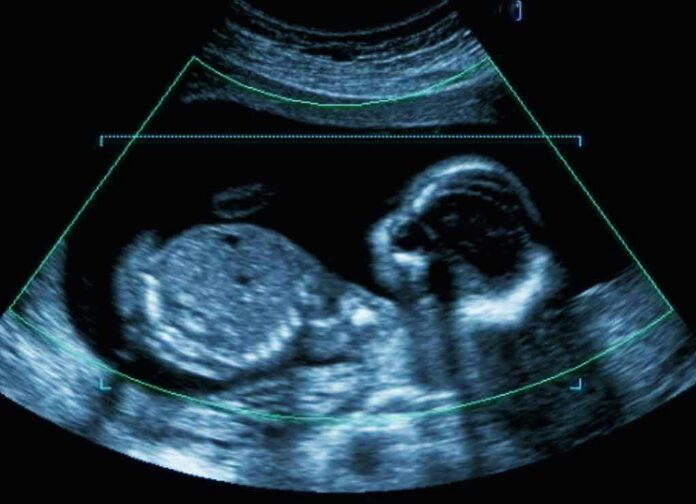
By the third trimester, a baby in the womb is not a passive passenger but an active, sensing body whose movements and expressions can intersect with family life in ways that feel almost impossibly intimate—yet those moments, like the viral “smiling at dad’s voice” ultrasound, are as much physiology and practice as they are emotion and story.
At a Glance
- A 32‑week ultrasound showed an unborn baby girl’s face shift into what looks unmistakably like a smile just after her father spoke—an event witnessed, filmed, and widely reported.
- By this stage of pregnancy, fetal hearing is well developed, and studies show fetuses respond to voices and other sounds, sometimes in measurable, repeatable ways.
- Scientific work with 4D ultrasound has documented “smile‑like” and “laughter‑like” facial patterns in utero, but these are considered reflexive practice movements rather than signs of conscious happiness.
- The heartwarming narrative that the baby “smiled at dad’s voice” rests on timing and interpretation; physiology supports the possibility of voice recognition, but not a proven emotional response.
A Viral Moment: What Actually Happened in the Scan Room
The starting point is straightforward: during a routine 32‑week ultrasound, an unborn baby girl’s face changed in a way that looked, to everyone present and later to millions online, like a smile appearing in response to her father’s voice. In the clip and in multiple reports, the father leans toward his partner’s abdomen, speaks gently to his daughter, even kisses the belly, then straightens up—at which point the ultrasound monitor shows the fetus’s mouth corners lift in a distinct, coordinated expression. The baby’s mother, Lia Oliveira, has said her sister was filming the ultrasound in Ontario when this unfolded, and that the room erupted in surprise and delight.
Coverage across outlets from lifestyle media to regional news has told the same basic story: a third‑trimester fetus, a 3D/4D ultrasound image, a father’s familiar voice, and a facial expression that looks so much like a smile that the “daddy’s girl” caption almost writes itself. The sequence is not in dispute; what is disputed, quietly but importantly, is what that sequence means.
What 32‑Week Fetuses Can Actually Hear and Do
To make sense of the clip, you have to start with fetal physiology. By the end of the second trimester, the inner ear—cochlea and associated structures—is largely formed, and by the third trimester, hearing is considered functional enough that fetuses respond to external sound. WebMD’s overview of life in the womb notes that by late pregnancy, fetuses react to voices and other noises, turning or moving in response; clinicians have long observed that they startle to loud sounds and calm to familiar rhythms. Experimental work summarized by the Charlotte Lozier Institute and others describes fetuses moving after low‑frequency sounds such as a father’s voice, once the ear structures and neural pathways are in place.
More precise evidence comes from developmental psychobiology. In one PubMed‑indexed study, researchers played recordings of mothers and fathers reading stories to fetuses and then newborns; fetuses showed sustained heart‑rate increases to both voices, and newborns later demonstrated a preference for their mother’s voice. The key point is not preference but capacity: in late pregnancy, fetuses can detect and physiologically respond to both parents’ voices. Other summaries of Kisilevsky’s work highlight consistent responding to external sounds between roughly 22 and 24 weeks—early signs of auditory learning and voice recognition that continue into the third trimester.
Smiling Before Birth: What 4D Ultrasound Has Revealed
The second pillar is facial expression. Once 4D ultrasound (essentially moving 3D imaging) became widely available, researchers began cataloguing fetal facial movements with far greater precision. A landmark study on “smiles in the fetal period” examined coordinated patterns of mouth and cheek muscle activity and identified gestalts—configurations—that closely resemble smiling and even laughter in newborns. By the third trimester, fetuses produce complex, repeated sequences: mouth corners lifting, cheeks tightening, eyes narrowing, all in patterns that map onto postnatal expressions.
Popular science explainers have made this research more accessible. One such video describes how Durham University investigators watched random twitches evolve into organized facial expressions, including a “laughter gestalt,” months before birth. Crucially, the lead researcher, Nadja Reissland, has stressed that these fetal smiles are not evidence of emotional joy; they are practice, patterned motor activity driven by the developing nervous system. Babies born blind, who have never seen a face, nonetheless smile with the same muscle pattern and timing as sighted infants, reinforcing the conclusion that smiling is hard‑wired and rehearsed long before social meaning attaches to it.
Between Science and Story: Interpreting the Oliveira Scan
Against that backdrop, the Oliveira ultrasound sits right on the boundary between science and narrative. On the scientific side, there is nothing implausible about a 32‑week fetus hearing a parent’s voice and producing a facial movement that looks like a smile. Hearing is functional; voice recognition can emerge with repeated exposure; facial motor patterns for smiling exist and are observed in utero. The doctor in the original viral description reinforces this, remarking that by this point “the baby is definitely listening” if the family talks at home and will begin to identify them.
On the narrative side, the language quickly upgrades from “appeared to smile” to “smiled at dad’s voice” and, in some advocacy and lifestyle framings, to more emotionally loaded claims about bonding, joy, and intentional response. The evidentiary record, however, consists of a single short clip, eyewitness accounts from those in the room, and many reposts. There is no full ultrasound file with device timestamps, no audio‑synchronized analysis, no repeated trials. The moment is clearly real; what it proves is much narrower than the captions often suggest.
What We Can Say Confidently—and What We Cannot
An expert reading has to separate three layers: movement, timing, and meaning.
First, movement. The face in the video shows a coordinated change: mouth corners lift, forming a recognizable grin. This is not a random flicker of one muscle group; it matches documented fetal “smile” patterns in third‑trimester imaging studies. That supports the claim that the baby’s expression is genuinely smile‑like, in a motor sense, rather than an artifact of angle or shadow.
Second, timing. Reports consistently describe the smile appearing just after the father speaks and pulls away, with some outlets quoting his specific words—an affectionate greeting, a light question, then the expression. Observers in the room perceived the smile as a direct response, and the viral framing rests on that subjective impression. Technically, we do not have the tools, in this case, to rule out coincidence: fetuses produce spontaneous facial movements; without a baseline or repeated stimulus cycles, causation cannot be established from a single event. Even sympathetic coverage in Arabic and other languages acknowledges that medical professionals cannot “settle” the question of direct stimulus‑response from this clip alone.
Third, meaning. Here the science is clearest. The best available evidence indicates that fetal smiles are reflexive practice movements, not conscious emotional experiences of happiness. Neural architecture for complex emotion and self‑aware social interaction matures after birth; the social smile that parents recognize—longer, eye‑crinkling, clearly directed at another person—emerges around 6 to 8 weeks postnatally and is distinct from the shorter, sleep‑linked reflex smiles observed earlier. To say the baby “felt joy” at her father’s words goes beyond what the data support.
Voice, Bonding, and the Real Power of Prenatal Interaction
If we strip away the romantic overstatement, a genuinely powerful story remains. Repeated exposure to a parent’s voice in utero appears to shape the baby’s auditory landscape and may influence postnatal calming responses and early bonding. Summaries of Kisilevsky’s and related work note that fetuses can learn and remember specific voice patterns, and that babies after birth sometimes show measurable changes—heart rate, quieting, gaze—when they hear familiar voices they knew from the womb. Other popularized research describes newborn brains as “wired to recognize the voices they heard in the womb,” particularly those of parents who spoke often near the belly.
From a practical standpoint, this means that the father in the Oliveira video was probably doing something that matters whether or not his daughter truly “smiled at” his greeting. Regular, affectionate talking, reading, or singing to the baby during pregnancy creates a consistent auditory cue; the fetus’ developing nervous system registers those patterns, and the newborn’s early world then contains at least one sound that is already known. The Oliveira clip is a particularly photogenic snapshot of that ongoing process.
Why These Stories Go Viral—and Why Skeptics Push Back
This ultrasound story belongs to a larger genre of viral prenatal videos: babies “laughing” in the womb, “grimacing” at unpleasant tastes, “reaching out” to touch a twin, “turning toward” facelike light patterns through the uterine wall. Many of these emerge from real scientific observations—documented changes in movement or physiology in response to stimuli—then gain narrative layers as they circulate. Social platforms amplify the most emotionally resonant framing: recognition, affection, personality.
Skeptics, including practicing sonographers and pediatric specialists, often respond by re‑anchoring the conversation in motor development. Comments on reposts of the “smiling at dad’s voice” clip characterize the expression as a reflex, noting that genuine social smiles start weeks after birth and that third‑trimester facial movements are best understood as the nervous system rehearsing patterns it will need later. Some professional commentary goes further, warning that there is “no link” demonstrating fetuses at 32 weeks respond with smiles to outside input, even if they can hear and even if the timing tempts that conclusion.
The tension is understandable. On one side is a deeply human desire to see personality and love in the earliest images of our children; on the other is a medical obligation not to overstate what a single ultrasound frame proves. Viral repetition can harden the sentimental interpretation long before careful explanation catches up, which is why developmental scientists spend so much time repeating a deceptively simple message: yes, your baby is active, sensing, and learning in the womb—but no, that does not mean every cute movement is a conscious emotional reaction.
Baby smiles hearing Dad’s voice
Pre birth interactions help strengthen the bond between mom’s and dad’s with their baby. It’s touching to see the genuine love the father has for his unborn child. All children need to have unconditional love from both parents. Each parent brings…
— Patricia 🇺🇸 (@1109Patricia) July 31, 2026
How to Watch Your Own Ultrasound with Clear Eyes and Full Heart
For parents who will sit in darkened exam rooms watching grainy or high‑resolution images of their unborn child, the lesson from the Oliveira clip and the surrounding science is not to dampen joy; it is to deepen understanding. When you see a hand rise toward the face, a yawn, a frown, or a fleeting smile, you are witnessing the nervous system assemble the repertoire of motions your baby will use to eat, cry, gaze, and, eventually, truly smile at you. The fact that those practice runs sometimes coincide with your voice or touch is not trivial. It reflects real sensory capacities and the beginnings of patterned, embodied experience.
But you do yourself and your child a favor when you hold two truths at once: the moment is emotionally meaningful because of what it symbolizes for your family, and scientifically modest in what it proves about the baby’s inner life. The unborn girl in the viral ultrasound almost certainly did hear her father’s voice. She just as certainly did produce a motor pattern that we recognize as a smile. Whether those two events were causally linked, and what they meant to her, are questions that sit beyond the reach of that brief video—and squarely within the territory where love, not data, supplies the answer.
Sources:
facebook.com, youtube.com, timesofindia.indiatimes.com, dailycitizen.focusonthefamily.com, instagram.com, linkedin.com, focus.de, ournigerianews.com, dailymail.co.uk, lozierinstitute.org, adatewithbaby.com