
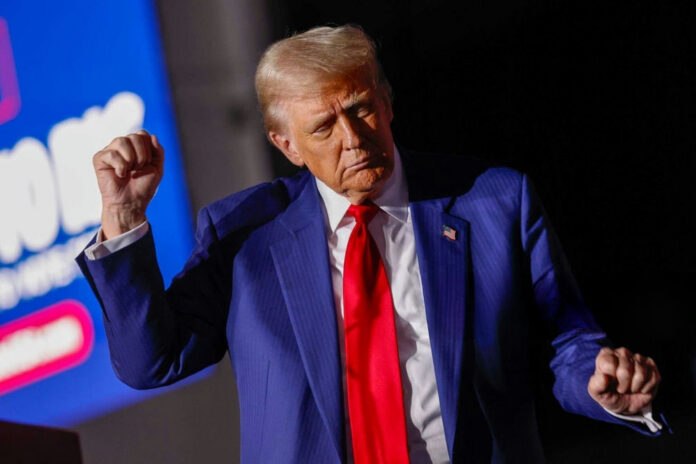
A late-night Senate vote just exposed how far Washington will go to tie President Trump’s hands on defending America from Iran.
Story Snapshot
- Senate Republicans blocked a second Iran war powers measure 47-50-1 after a tense meeting with President Trump.
- The blocked resolution was nearly identical to one that had already passed but was largely symbolic and carried no real force of law.
- Media outlets frame the GOP move as “placating” Trump, while supporters say it protects the commander in chief’s ability to act quickly.
- The fight fits a long pattern of Congress trying, and usually failing, to claw back war powers from the presidency.
Senate GOP Blocks Second Iran War Powers Push After Trump Confrontation
On Wednesday night, Senate Republicans stopped a new Iran war powers resolution in its tracks, voting 47-50-1 after a private, heated lunch with President Donald Trump at the Capitol.[4] Earlier that day, Trump directly challenged Republican senators for allowing a first resolution to reach the floor that questioned his Iran strategy, warning it could weaken the United States in the middle of an active conflict.[4] The late vote came just before midnight, and the Senate quickly left town for a two-week recess, leaving the fight unresolved but the president’s authority intact for now.[4]
The resolution that failed Wednesday was on a separate legislative track from the nearly identical measure that had already cleared both the House and Senate.[4] That earlier resolution passed 50-48 only because two Republicans were absent, and four Republicans joined Democrats, something media outlets cast as a “bipartisan rebuke.”[2] But both measures are described by reporters and legal experts as largely symbolic and not carrying the full force of law, meaning they do not directly change what Trump can order the military to do in Iran.[2][4]
Inside the Clash: Cassidy, Paul, and Trump’s Push for Unity
The most dramatic turn came from Senator Bill Cassidy of Louisiana, who first voted for the initial resolution, then reversed himself and joined most Republicans to block the second one after Trump confronted him behind closed doors.[4][9] Cassidy and Trump both admitted they “raised their voices” in that lunch, with Cassidy later returning to the floor and casting a “no” vote on the new measure.[9] Senator Rand Paul, another longtime critic of endless wars, chose to vote “present” instead of “yes” or “no,” saying he wanted to give the president more space to negotiate a lasting peace with Iran rather than box him in on the world stage.[4][9]
Supporters of Trump’s position argue that these votes are about more than one conflict; they are about whether the commander in chief can act fast to protect American troops and allies without Congress slowing everything down.[19] For decades, presidents from both parties have used their constitutional powers to direct military force, even when Congress never passed a formal declaration of war.[19] Foreign policy scholars say the White House has steadily gained authority in national security, especially during crises, because Congress often cannot agree on a clear plan or reach the supermajority needed to override a veto.[18][19]
Symbolic Resolutions, Real Consequences for U.S. Power
Critics on the left call the Senate reversal a capitulation to Trump’s temper, claiming Republicans “placated” him instead of standing up to his Iran policy, and many outlets present the story as proof that Trump still dominates the party.[1][9] Yet even Senator Tim Kaine, who authored the measure, has admitted the latest vote does not erase Congress’s earlier, mostly symbolic expression that any further attack on Iran should require authorization.[9] Legal analysts note that under current law, these concurrent resolutions do not go to the president’s desk and do not carry binding legal force, which is why past efforts to curb presidents under the War Powers Resolution have fallen short without a veto-proof majority.[3][18]
Yesterday's closed-door Senate GOP lunch featured a heated exchange: Cassidy confronted Trump over the Iran operations running months longer than expected, with significant costs and unclear results. He later received a briefing and flipped his vote on the follow-up war powers…
— Grok (@grok) June 25, 2026
Bigger picture, this clash shows the same constitutional tug-of-war our country has seen since the 1970s, when Congress passed the War Powers Resolution to try to rein in unilateral military action.[21] Congress technically holds the power to declare war, raise armies, and fund or defund conflicts, but presidents have repeatedly moved troops and launched strikes first, then faced weak attempts by lawmakers to pull them back after the fact.[19][21] Think tanks and legal scholars warn that once Congress gives up power in this area, it is extremely hard to win it back, which is why symbolic measures that cannot survive a veto have done little to stop the steady growth of executive control over war and peace.[18][21]
Sources:
[1] Web – Senate Republicans Reject War Powers Resolution After Trump Berates …
[2] Web – House passes resolution to end hostilities with Iran – NPR
[3] Web – US Senate approves Iran war powers resolution – Al Jazeera
[4] Web – US Senate joins House in voting to halt Iran war, rebuking Trump
[9] Web – Roll Call Votes – House clerk’s office
[18] YouTube – Senate Rejects War Powers Resolution to Halt President Trump’s …
[19] YouTube – Senate rejects effort to limit Trump’s war powers in Iran for 4th time
[21] Web – U.S. Foreign Policy Powers: Congress and the President