
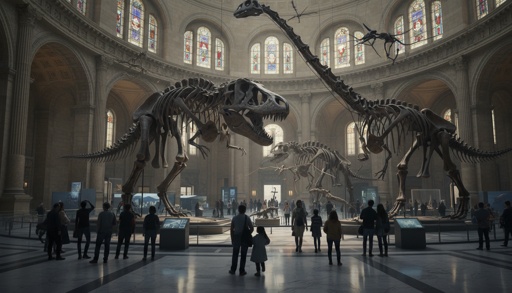
A rare Montana fossil shows a Tyrannosaurus rex driving a tooth straight into another dinosaur’s face, freezing a real attack in stone.
Story Snapshot
- An Edmontosaurus skull from Montana holds an adult T. rex tooth embedded in its snout.
- The bite came from the front and matches active hunting, not casual feeding.
- Lack of healing around the wound suggests the attack happened at or near the time of death.
- This “caught in the act” fossil adds to growing proof that T. rex was a true predator, not just a scavenger.
A face bite that captured a deadly encounter
In the Hell Creek rock formations of eastern Montana, scientists found an almost complete skull from the duck-billed dinosaur Edmontosaurus. The skull, cataloged as MOR 1627 and now housed at the Museum of the Rockies, contains a stunning detail. A broken tyrannosaur tooth tip is lodged deep in the top of the animal’s snout, penetrating into the nasal cavity. This is not a random chip or scratch. It is clear physical evidence of a powerful strike right to the face.
The embedded tooth has been carefully matched against all known meat-eating dinosaurs that lived with Edmontosaurus in that area. By studying the tooth’s size, shape, and serrations, researchers found it lines up with a middle–posterior tooth from an adult Tyrannosaurus. That means this was not a small juvenile nibbling on a carcass. It was a full-grown T. rex, with an estimated skull length of around one meter, delivering a direct and forceful bite into the front of its prey’s head.
Why the fossil points to a live attack, not scavenging
The position and angle of the tooth are critical for understanding what happened. The tooth is oriented so that it points downward and slightly forward, and the curvature shows the bite came from directly in front of the Edmontosaurus. Tooth marks across the snout match this same event. Scientists argue that a single, strong bite to the nose is behavior seen in hunting, meant to disable or kill, rather than in feeding on a body already on the ground. A scavenger more often bites softer, fleshier parts, not bone-heavy snouts.
Another key clue is how the bone around the embedded tooth looks. In a famous earlier fossil from South Dakota, a T. rex tooth stuck in a hadrosaur tail is surrounded by rough, healed bone growth. That healing proves the duckbill survived the attack and lived for some time afterward, forcing experts to admit this was true predation. In the Montana skull, by contrast, there is no similar healing around the facial wound. That lack of repair suggests the bite happened at or shortly before the Edmontosaurus died, making a lethal or near-lethal strike more likely.
This fossil in the long debate over T. rex behavior
For years, some scientists claimed Tyrannosaurus rex was mainly a scavenger, living off dead animals instead of chasing live prey. That idea appealed to people who doubt strong predators and like to question “dominant” narratives, a pattern we often see in modern politics and media, too. But fossil after fossil has undercut the scavenger-only story. Bite marks, embedded teeth, and immense bite-force studies now show T. rex had the tools and the track record of an apex hunter. The Montana skull adds fresh fuel to that side of the debate.
The new study on MOR 1627, published in the journal PeerJ, is careful and detailed. The authors admit that scavenging cannot be completely ruled out, because bones alone rarely tell the whole story. Even so, they conclude that predation is more likely for this skull. They point to the direction of the bite, the number and placement of tooth marks, and the fact that the skull stayed well articulated, which fits a fast, violent encounter. In plain terms, the evidence lines up better with a live attack than with a T. rex quietly stripping meat off a long-dead carcass.
Putting MOR 1627 beside other “caught in the act” fossils
This is not the first time a T. rex tooth has been found jammed in hadrosaur bone. A 2010 discovery from the Hell Creek Formation in South Dakota revealed a tooth crown embedded in two fused tail vertebrae of an Edmontosaurus. In that case, healed bone growth partially covered the tooth, proving the animal was alive when bitten and survived the attack for some time. Researchers called it “definitive evidence of predation,” showing T. rex bit living prey, not just carcasses. Together with MOR 1627, these fossils show T. rex attacks from different angles—tail and face.
Rare fossil evidence shows a face-to-face T. rex bite: an Edmontosaurus skull with a embedded Tyrannosaurus tooth reveals how ferocious and precise Rex predation was. A dramatic window into ancient hunting behavior. #Paleontology #T rex #Fossils https://t.co/IgMYGrOlaQ
— Devin Womack (@devinwo) July 14, 2026
Popular videos and museum displays today often tell the public that T. rex was both a hunter and a scavenger. That view may be fair, because many modern predators, like lions, will eat a free carcass if they find one. But the growing fossil record, including the broken adult T. rex tooth in MOR 1627’s snout, makes it harder to paint T. rex as some lazy, lumbering trash eater. Instead, it looks more like a powerful, active predator that sometimes scavenged—much like real top carnivores do now.
Sources:
sciencedaily.com, pnas.org, scmp.com, pubmed.ncbi.nlm.nih.gov, nationalgeographic.com, dailymail.co.uk