
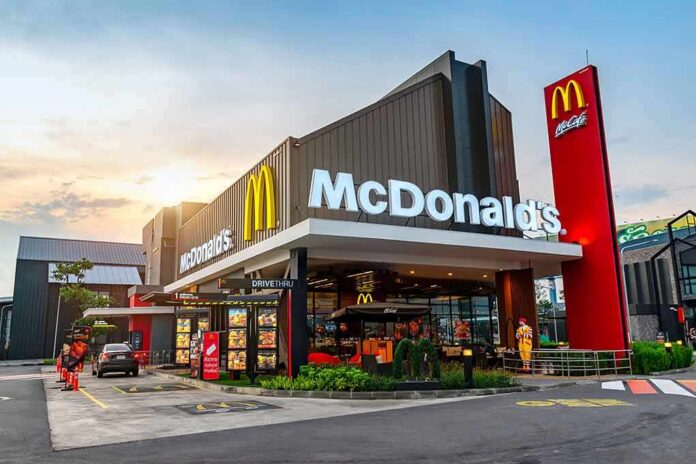
Algorithmic pricing is forcing a once-comfortable distinction to the surface: when a franchisor’s software ingests sensitive, store-level data from thousands of nominally independent outlets and returns “optimal” prices, is that ordinary brand management—or a hub that coordinates competitors’ prices by proxy?
At a Glance
- A proposed nationwide class action alleges McDonald’s used an AI-powered pricing engine to coordinate menu prices among franchisees.
- The mechanism at issue is not a single “set price,” but centralized recommendations built from nonpublic, store-level data across nearly 14,000 U.S. restaurants.
- McDonald’s counters that franchisees set their own prices and that its portal is an optional analytics tool, not a mandate.
- The legal frontier mirrors the government’s RealPage case: the antitrust risk turns on shared sensitive data and reliance on a common algorithm, not labels like “AI.”
What the lawsuit actually alleges—and why the mechanism matters
The complaint, filed in federal court in Chicago, frames a straightforward antitrust theory updated for modern tooling: McDonald’s allegedly gathered nonpublic, store-level sales and pricing data across its U.S. system and fed that information into a machine-learning engine that generated location-specific “optimal” prices, which franchisees were expected—if not strictly required—to follow. The claim does not rest on a single number sent to all outlets; it rests on the allegation that rivals in the same local markets supplied competitively sensitive inputs to a central platform that returned recommendations shaped by their combined data, dampening independent price rivalry at the street level. Reuters’ reporting described a system analyzing millions of daily transactions across almost 14,000 restaurants to produce recommended prices—a scale that, if paired with meaningful adherence, could plausibly shift market outcomes.
The plaintiffs also point to the franchisor–franchisee relationship as a vector of influence: even though about 95% of U.S. restaurants are independently owned, the suit alleges McDonald’s monitored and pressured compliance with the engine’s pricing outputs. On its face, that turns the case from “many owners independently buying the same commercial software” into “a single brand collecting rivals’ confidential data and steering their pricing,” a distinction antitrust courts have cared about long before “AI” became the label of choice. The requested relief is conventional—class certification, damages, and an injunction barring practices alleged to restrict competition—underscoring that this is a familiar legal frame applied to a novel tool.
McDonald’s counter: tools, not mandates; franchisees set prices
McDonald’s categorical response is crisp: “AI does not set the price of a Big Mac or any other menu item,” and “franchisees decide menu prices.” The company characterizes its portal as an optional, restaurant-specific recommendation tool that helps owners make informed decisions; it denies any automation, coordination, or price fixing. The company also portrays such analytics as common across industries. Taken at face value, that defense attacks two legal pillars at once: the existence of a horizontal agreement among competitors and the element of causation—i.e., that recommendations, rather than local costs and business judgment, determined prices. If discovery shows franchisees routinely ignored recommendations without consequence, the plaintiffs’ theory weakens substantially.
At the same time, the company’s assurances do not, by themselves, resolve the question that matters in algorithmic-collusion cases: whether a shared, competitively sensitive data exchange combined with substantial deference to a common set of recommendations functioned as coordinated pricing in practice. That assessment turns on facts the public record does not yet supply—override rates, compliance monitoring, and whether recommendations were materially shaped by nearby franchisees’ nonpublic data.
The antitrust lens: from explicit meetings to algorithmic hubs
Antitrust law has long prohibited competitors from agreeing on prices, but modern enforcement no longer requires an ashtray full of cartel meeting minutes. The Justice Department’s case against RealPage pressed an analogous hub-and-spoke theory: landlords allegedly supplied nonpublic rents and occupancy information to a vendor whose software produced coordinated pricing recommendations across competitors. The government’s core contention was not “AI is bad”; it was that a shared intermediary, armed with rivals’ sensitive inputs and substantial user adherence, replaced independent decision-making with coordinated outcomes. That is the lens through which the McDonald’s dispute will be evaluated.
Academic and practitioner literature reinforces the point. Pricing algorithms can, under identifiable conditions, sustain supracompetitive prices—yet algorithms are not per se unlawful; the inquiry is intensely factual, focused on the nature of the data, the structure of the platform, and the degree of reliance users place on its outputs. The legal question is whether the conduct amounts to a horizontal agreement, express or tacit, effected through a common tool. Agreements to use a third-party or centralized algorithm as the starting point for prices, even with deviations, have drawn increasing scrutiny precisely because the “starting point” can anchor outcomes in ways that suppress competitive undercutting.
Franchise structure complicates—but does not preclude—the analysis
Franchise systems blur lines that antitrust draws bright: are outlets within a single brand independent competitors or a single economic enterprise for the conduct at issue? Courts have treated different aspects of franchisor control differently across contexts. The plaintiffs here will argue that local price setting is paradigmatically competitive behavior between nearby franchisees and that sharing of nonpublic, store-level data—with ensuing adherence to common recommendations—constitutes horizontal coordination. McDonald’s will emphasize uniform brand management, common analytics, and owner autonomy to accept or reject advice. Which view prevails will turn on evidence of how the pricing engine operated, how it used competitors’ data, and what practical consequences attached to following—or defying—its guidance.
That is why the missing pieces loom large: the complaint’s docket, exhibits, system documentation, and audit logs would show whether the engine ingested competitor-specific inputs, whether McDonald’s tracked compliance, and how often franchisees overrode recommendations without friction. Without those, outside observers cannot credibly declare victory for either theory. The case is in an early procedural posture; no court has adjudicated liability or certified a class.
What would settle the question: the fact pattern to watch
Four categories of evidence will decide this matter. First, data architecture and governance: did the platform use nearby franchisees’ nonpublic prices and sales to shape a store’s “optimal” recommendation, and could users see or infer competitor-level inputs? Second, adherence and enforcement: what share of recommendations were adopted, how quickly, and what happened when an owner deviated? Third, causation: did recommended prices predict actual prices controlling for wages, rent, food costs, and local demand? Fourth, intent and communications: did internal materials describe the tool as coordinating or harmonizing prices, and did franchisee groups discuss aligning around its outputs?
An affirmative answer across those dimensions would make the plaintiffs’ case look like algorithmic coordination rather than benign analytics. A record showing high override rates, store-specific cost drivers dominating outcomes, and no enforcement pressure would instead validate McDonald’s framing of the tool as optional decision support.
Why this matters beyond one brand
Whatever its outcome, this dispute will shape how franchisors and multi-outlet networks deploy pricing software. The signal to industry is already clear: centralizing nonpublic, store-level data from nominal competitors and returning price recommendations invites a hub-and-spoke analysis, especially if users substantially adhere to the outputs. Firms that want the benefits of analytics without the legal exposure have options—segregate sensitive data, limit models to cost inputs rather than rivals’ realized prices, document autonomy and high override rates, and avoid any conduct that resembles monitoring or penalizing deviations.
For consumers, the practical advice is less dramatic but more actionable: prices can vary meaningfully within short distances, with or without AI. Shopping across nearby locations remains the simplest check on local market power. For courts and enforcers, the work is empirical. The label “AI” is a distraction; the question is whether a shared intermediary replaced independent rivalry with coordinated outcomes—a question the RealPage litigation has already put squarely on the table.
Sources:
thegatewaypundit.com, reuters.com, rmb.reuters.com, apnews.com, newsweek.com, nrn.com