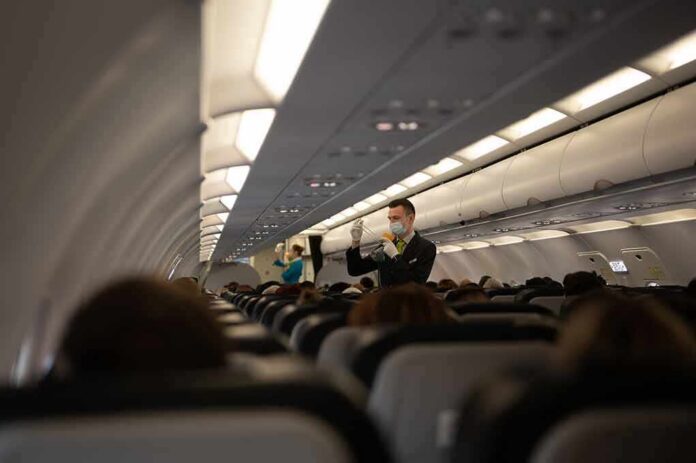
Airline cabins are tightly managed safety environments; when a passenger crosses into violence, the system engages in layers—from crew intervention to airport police to federal authorities—because assaults in the air are both crimes and aviation hazards.
At a Glance
- Authorities say Selma Blair injured two flight attendants aboard Delta Flight 938; one crew member was hospitalized for evaluation.
- Port Authority police detained Blair at JFK; federal authorities issued a notice related to assault aboard an aircraft.
- Blair’s representative attributes her behavior to a medical emergency; the case proceeds through state and federal channels.
- The incident fits a broader pattern: unruly-passenger events remain uncommon but consequential, with alcohol, stressors, and enforcement shaping outcomes.
What happened aboard Delta Flight 938
On a late-night Los Angeles–to–New York run, Delta Flight 938’s cabin crew called for help. By the time the aircraft rolled to the gate at JFK, Port Authority officers were waiting to detain actor Selma Blair. The Port Authority reported that two flight attendants had sustained injuries in an on-board altercation and that one was transported to a hospital for further evaluation, triggering the standard handoff between airport police and federal authorities who examine potential violations tied to in-flight assaults. Several outlets, citing law enforcement and airline sources, reported allegations that one crew member was bitten—an injury pattern consistent with close-quarters scuffles inside narrow aisles and galleys.
Because serious interference with or assault on flight crew falls under federal jurisdiction when it occurs in the air, the FBI was notified and a federal process initiated alongside state proceedings. CNN and the Associated Press each reported that Blair was detained upon arrival and that federal authorities opened an assault matter related to her on-board conduct. Blair’s representatives, across multiple outlets, have said she experienced a medical emergency that precipitated the behavior; that claim does not resolve criminal exposure but often becomes relevant to charging decisions, diversion possibilities, or sentencing mitigation.
Why aviation treats in-flight assaults as different
Assault is a crime on the ground; at altitude it is a risk multiplier. Flight attendants are not merely service staff—they are the first line of safety and security compliance. Interfering with or attacking them can compromise evacuation readiness, distract the cockpit, and spark copycat escalation. Federal law treats these actions accordingly. When a crew reports violence, airlines move rapidly: isolate the passenger, notify the cockpit, coordinate with dispatch and law enforcement, and, if needed, prepare medical support at the destination. That choreography is designed for precisely the scenario reported on Flight 938. The Port Authority’s statement that two attendants were injured, with one sent for hospital evaluation, meets the typical threshold for federal notification and evidentiary preservation upon arrival.
Initial reports in high-profile cases often blend operational detail (injury descriptions, timing) with legal posture (detention, charges, summons). Here, the backbone facts align across reputable outlets: detained at JFK, injuries to two crew members, and a federal notice tied to an on-board assault allegation. From there, the justice system bifurcates—state charges can address conduct on the ground or at the gate, while federal proceedings address the in-flight elements.
Medical emergencies, culpability, and what courts sort out
Blair’s team has stated that a medical emergency led to the behavior. In aviation and criminal contexts, “medical emergency” is an umbrella phrase that can include acute illness, neurological episodes, drug interactions, or psychiatric crises. It can co-exist with real harm to others. Prosecutors still assess evidence of intent, capacity, and risk; defense counsel can raise medical causation to argue diminished mens rea (criminal intent) or to seek diversion to treatment, but those arguments are tested against witness accounts, injury documentation, and any available audio or video from the cabin. That is why early coverage anchors to what is least disputable—crew injuries, custody status, and the federal referral—while the question of why remains for forensics, medical records, and, ultimately, court findings.
Commercial aviation has seen analogous cases where post-incident evaluations materially shaped outcomes—sometimes leading to reduced charges or mandated treatment, other times resulting in convictions when evidence showed clear, dangerous interference. The presence of a claimed medical trigger neither confirms nor negates criminal liability; it prompts a different line of inquiry and potential resolution.
Actor Selma Blair has reportedly been arrested following an alleged altercation on board a Delta flight#SelmaBlair #Hollywood #DeltaAirLines #BreakingNews #EntertainmentNews #WION pic.twitter.com/OnajLQlCdL
— WION (@WIONews) October 13, 2026
How this incident fits the wider pattern of unruly-passenger behavior
While the overwhelming majority of flights are uneventful, disruptive-passenger incidents have persisted since the pandemic spike. The National Academies summarize the arc: nearly 6,000 reports to the FAA in 2021, roughly halving in 2022, then declining another 15% in 2023—still above pre-2020 baselines. Researchers studying causation consistently identify alcohol and situational stressors—delays, tight seating, and perceived inequities in the cabin—as contributors that can push a fraction of fliers over the line from noncompliance to verbal or physical misconduct. Airlines and regulators, in response, hardened a zero-tolerance posture and expanded civil penalties; enforcement, however, remains uneven because incidents unfold quickly and evidence can be fragmented.
What distinguishes the Flight 938 account is the allegation of injuries to crew. Physical harm, even short of serious bodily injury, is a bright line in aviation operations. It transforms a customer-service dispute into a safety event, triggers documentation and medical evaluation, and, most importantly, shifts jurisdiction toward federal oversight when the conduct occurs in flight. That is why the Port Authority’s hospital evaluation reference and the FBI’s involvement loom large in the factual core of this case.
Operational mechanics: from aisle to arraignment
Cabin crews are trained to de-escalate first: calm language, clear instructions, and seat changes when possible. If violence erupts, the playbook is containment—restrain if necessary, enlist able-bodied passengers discreetly, and inform the cockpit. The captain, balancing fuel, airspace, and medical risk, decides whether to divert or continue; here, the flight continued to JFK, with medical personnel requested to meet the aircraft. On the ground, airport police take custody, gather statements, and coordinate with federal agents when statutes covering interference with crew potentially apply. Prosecutors then decide on charges spanning any in-flight assaults and any additional conduct during transport or hospital evaluation. This layered system exists precisely because the cabin is a closed environment where minutes matter and evidence, often limited to injury patterns and contemporaneous reports, must be secured quickly.
The subsequent legal path can involve parallel forums: a federal summons or complaint addressing on-board assaults, and state charges for any post-landing offenses. Courts commonly impose stay-away orders from victims, no-fly conditions as a bail term, mandated treatment when medical factors are credibly substantiated, and restitution for medical bills or airline costs. The headline risk—felony exposure for assaulting crew—drives most plea negotiations when injuries are documented.
What to watch as the case proceeds
Three elements usually prove dispositive. First, the quality and consistency of crew and passenger statements and any corroborating audio from cockpit or dispatch. Second, medical documentation—both for injured crew and for the passenger asserting a medical crisis. Third, prosecutorial posture: whether federal authorities pursue interference-with-crew charges or resolve with a lesser assault count. In high-visibility cases, the interplay between demonstrated harm and a verified medical etiology often sets the ceiling and floor for outcomes. Here, the convergence of reports on crew injuries and federal involvement is firm; the explanation for the behavior is the live question for the courts to evaluate.
Sources:
abcnews.com, bbc.co.uk, apnews.com, cnn.com, pmc.ncbi.nlm.nih.gov, productiveclue.com