
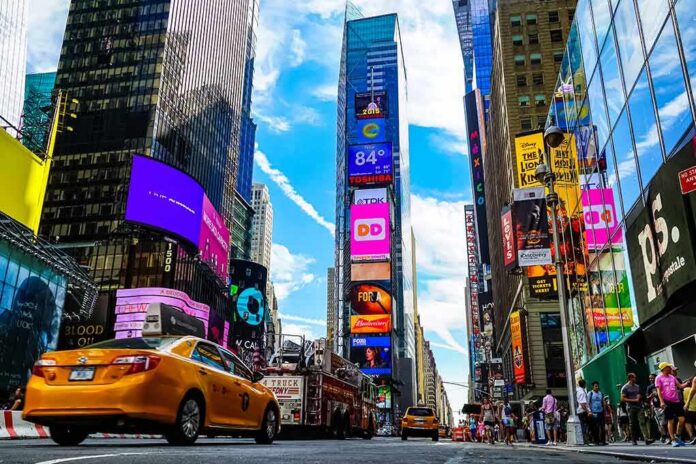
When a heavy truck meets a vulnerable road user in a dense corridor, physics and street geometry make the outcome tragically predictable—what happened in Herald Square is not an anomaly but a recurring pattern that cities can diagnose and reduce if they treat it with the same rigor they bring to aviation or rail safety.
The Short Version
- Police say a dump truck struck a bicyclist on West 34th Street near Seventh Avenue in Herald Square around 10:50 a.m., then continued westbound.
- EMS pronounced the rider, a 50-year-old woman working a delivery shift, dead at the scene.
- Officers stopped and impounded a New Jersey–plated dump truck on Fifth Avenue at 35th Street; the driver was questioned as the investigation continued.
- Heavy trucks are disproportionately involved in cyclist fatalities in urban settings due to mass, blind zones, and turning conflicts; proven countermeasures exist and should be standard.
What happened on West 34th Street, and what police established quickly
Late morning in Midtown, police received reports of a collision involving a dump truck and a person riding an e-bike on West 34th Street near Seventh Avenue, steps from Macy’s Herald Square. According to NYPD accounts relayed by local outlets, the crash occurred just after 10:50 a.m.; EMS responded and pronounced the rider—a 50-year-old woman performing delivery work—dead at the scene. Witness descriptions helped officers identify and stop a New Jersey–plated dump truck, described as an approximately 80,000-pound vehicle, at Fifth Avenue and 35th Street. The truck was impounded and the 36-year-old driver questioned while the collision investigation proceeded. Initial reports indicated the truck continued westbound after impact before officers intercepted it nearby.
The essential facts were consistent across multiple outlets, including the location in the heart of Herald Square and the sequence—impact on 34th Street near Seventh Avenue, EMS pronouncement at scene, and a subsequent vehicle stop one block north and one avenue east. Police indicated no immediate charges at the time of questioning, a procedural posture that often reflects the need for full crash reconstruction and evidentiary review rather than a final charging decision.
Why trucks and bikes collide in cities: mass, geometry, and sightlines
Urban truck–bicycle conflicts are not merely about individual behavior; they are structured by vehicle design and street form. Large trucks carry kinetic energy vastly higher than passenger vehicles at the same speed, and their elevated cabs and long wheelbases create extensive blind zones adjacent to the front right quarter and along the flanks. In mixed-traffic corridors with curbside loading, bus lanes, and bike lanes threading past wide intersections, the most dangerous phase is often the turn. Multiple empirical reviews have found heavy vehicles disproportionately represented in cyclist fatalities in urban settings, particularly at intersections and at relatively low speeds where “swept-under” mechanisms account for lethality even when the initial impact is not catastrophic.
In peer-reviewed work using a safe-system lens—a framework that assumes humans err and designs roads and vehicles to prevent those errors from causing death—researchers report that heavy vehicles are involved in a materially higher share of fatal bicycle crashes in cities than their modest traffic share would predict. Urban fatal cyclist crashes show higher rates of intersection involvement, turning movements, and run-over injuries characteristic of truck conflicts. The reason is mechanical: high cabs, A-pillar occlusions, and trailer off-tracking can mask a cyclist’s presence until it is too late for either party to avoid contact.
Herald Square as a risk environment: the corridor’s operational realities
West 34th Street is a freight and retail spine serving department stores, hotels, and Penn Station’s catchment. Even off-peak, it mixes bus operations, curbside deliveries, and constant pickups and drop-offs. That density produces frequent lateral merges, stop-and-go platoons, and turning pressure at the Seventh Avenue and Sixth Avenue junctions—exactly the conditions that elevate conflict probability between a large truck and a cyclist traveling in the same direction. In that milieu, a delivery worker on an e-bike—faster than a standard bike, often filtering alongside queued vehicles—may enter or exit a truck’s blind zone unpredictably from the driver’s perspective, particularly if a truck begins a lane change or turn while scanning for gaps ahead rather than to the immediate right.
None of that absolves responsibility; it explains the failure modes the system predictably yields when vehicle design, operational demands, and street geometry interact. Safe-system practice says we must harden the system where it fails most often—at turns, at curbs, and at truck interfaces—rather than rely on perfect vigilance from humans who will always make mistakes.
What an effective investigation should resolve
A modern crash investigation can answer the questions that matter for accountability and prevention: lane position and signal phase; whether the truck was turning or proceeding straight; the cyclist’s approach vector; contact point; and vehicle speed. Investigators commonly synthesize surveillance video, traffic-signal timing logs, event data from fleet telematics, witness statements, and forensic mapping of scrape, debris, and final rest points. In dense Midtown blocks studded with cameras, it is usually possible to reconstruct the sequence with high fidelity. That, in turn, informs both legal outcomes and targeted countermeasures at the exact conflict location.
Early reports noted that officers stopped and impounded the identified truck and interviewed the driver; that procedure typically precedes a detailed reconstruction and a determination by crash investigators and, if warranted, prosecutors. While initial briefings said no charges at that time, such posture is not dispositive; charging decisions often await full evidentiary packages and expert analysis.
Countermeasures that reduce deaths without waiting for culture change
Jurisdictions with the steepest reductions in truck–cyclist fatalities embrace engineering controls, procurement standards, and operational constraints tailored to the specific risk. High-payoff interventions include: side underride guards that prevent “sweep-under” runovers; convex and cross-over mirrors and camera systems that erase near-field blind zones; intelligent turn-assist sensors linked to audible and cab-visible alerts; protected intersections that slow and square turns while separating bicycle movements; and turn-phase signalization that eliminates simultaneous truck turning and through-bike conflicts. Systematic reviews and agency guidance converge on the same targets: reduce turning conflicts, make cyclists conspicuous in the driver’s field of view, and physically prevent runovers when contact occurs.
Policy levers exist today. Cities can require side guards, cameras, and turn-assist on all contracted and permitted heavy trucks; several global metros already do. Freight access plans can time and route large deliveries away from peak pedestrian and bicycle volumes on corridors like 34th Street. Curb management—clear sight triangles at intersections, daylighting to the stop bar, and relocation of loading to midblock bays—removes occlusions that currently mask vulnerable users from turning drivers. Each measure chips away at the chain of events that turns a routine turn or merge into a fatality.
Why this single Midtown death demands a structural response
The Herald Square crash is heartbreaking for its immediacy—a woman working a low-margin job dies in broad daylight on a marquee block—but the data tell us it is not a fluke. Urban cycling fatalities cluster at intersections, overrepresented by heavy vehicles, often at modest speeds that become lethal only because a rider is dragged under wheels or struck by a vehicle with a high, blunt front profile. That is a solvable engineering problem dressed up as a culture war. We know where and how these conflicts happen; we know which equipment and designs break the chain of causation. The only variable that remains is whether cities choose to treat these deaths as preventable system failures rather than as the price of doing business on a busy street.
Sources:
nypost.com, audacy.com, centsondollar.com, nyc.streetsblog.org, cbsnews.com